
Epigenetics refers to processes that alter gene activity without changing the DNA sequence. The DNA sequence remains the same, while some processes can change gene activity in the DNA. Today, several serious illnesses have links with epigenetic mechanisms, linking with almost all types of cancer, cognitive dysfunction, respiratory illness, and cardiovascular illness.
Behind this rigid process of gene alteration, there are several factors that are involved, such as exposure to heavy metals, pesticides, diesel exhaust, tobacco, hydrocarbons, radioactivity, germs and parasites, etc. The word epigenetics itself means “in addition to changes in genetic sequence”. There are several types of epigenetic processes such as methylation, acetylation, phosphorylation, ubiquitylation, and sumoylation. It is important to consider that epigenetics is integral and important to every living organism, but if the process takes place abruptly, it can lead to serious damage to health and behavioural effects(Weinhold,2006).
The article will explore epigenetics’ meaning, history and origin, and its important components. How the interplay between genes and environment impacts human behaviour, important mechanism which contribute to epigenetics and how epigenetics impacts psychological disorders.
Read More: Synaptic Transmission: How Information Travels in the Brain
The Components of Epigenetics: Cell, Chromosome, Gene and DNA
A cell is a basic functional unit of life. In the nucleus of each cell, there are chromosomes which contain DNA Molecules. DNA molecules are packed in a thread-like structure. Each chromosome is made up of DNA. Chromosomes become invisible in the cell; an individual cannot even see chromosomes under a microscope. The centromere divides the chromosome into two equal parts; it lies in the centre of the chromosome.
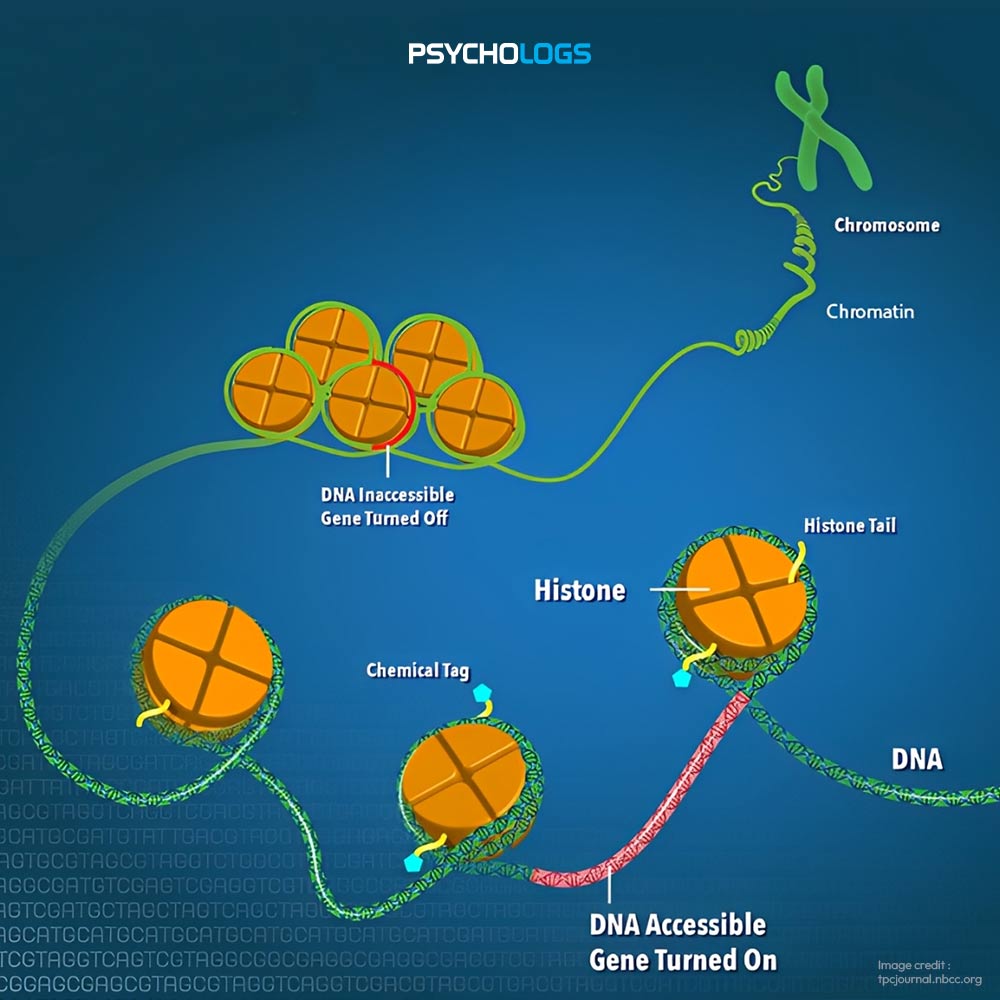
This divided part is known as an arm. The short arm is known as the p arm, while the long arm is known as the q arm. Centromere becomes important as they help to understand the sequence and location of specific genes. Deoxyribonucleic acid (DNA) is the hereditary material in human beings. Every cell has the same DNA.DNA is located in the chromosomes.
The DNA has segments or sections that become an important part of the physical or functional unit of heredity. In 1990 and 2003, the Human Genome Project, an international research project, estimated that humans have 20,000 to 25,000 genes in each cell that make proteins. Genes and Chromosomes are part of the DNA. The structure of DNA looks like a double helix structure(Medline Plus,2024; Medline Plus, 2021; MedlinePlus, 2021).
History and Origin of Epigenetics
The origin and history of epigenetics are related to the study of evolution and development. However, over the past 50 years, epigenetics itself has undergone an evolution because of enhanced interest and research in the field. There was an increase in the knowledge of molecular mechanisms of eukaryotes. The present-day definition is clearer and more concrete: “ Epigenetics is the study of mitotically and/or meiotically heritable changes in gene function that cannot be explained by changes in DNA sequence”. Until the 1950s, the word epigenetic was mostly used to describe the overall process that contributed to the final outcome, which means it was used to describe the process from fertilisation to birth.
The concept can be traced to the discipline of Cell Biology and Embryology during the 19th century. Embryologists debated one notion: what the component and the location of the component, which leads to the development of organisms. They divided themselves into two important groups because they all had conducted various yet confusing experiments. The first group advocated that each cell has elements that enlarge during development; this was known as ‘preformationism’.
Whereas the second group advocated a process involving a chemical reaction among soluble components that executed a complex developmental plan, this process was known as ‘epigenesis’. Epigenetics as an area of study and research has evolved through complex debate and discussion from disciplines such as cell biology and embryology (Felsenfeld, 2014).
Understanding the Basic Process of Epigenetics
To facilitate the complex patterning that is required for normal and healthy development, there are several types of epigenetic markers. These epigenetic marks include DNA methylation at CpG dinucleotides, covalent modifications of histone proteins, and noncoding RNAs (ncRNAs). These marks function in a very organised manner by regulating traits and gene expression, which are passed down from a parent cell to its daughter cell during mitosis. These marks are organised because they do not alter the DNA sequence. Epigenetic marks are influenced by both environmental factors and genetic factors.
DNA methylation, histone modifications, and ncRNAs are considered independent mechanisms. There is cross-talk between the different epigenetic marks to regulate the systems of chemical tags and proteins that are attached to the DNA (epigenome)(Inbar-Feigenberg et al.,2013).
1. DNA Methylation
At present, DNA Methylation is studied the most. DNA Methylation is related to reducing the expression of particular genes by adding methyl groups to DNA bases. In species like eukaryotic, the process of DNA Methylation involves the transfer of a methyl group to the core building block of DNA and RNA, which is known as cytosine. This transfer happens to a particular cytosine, which is known as a CpG dinucleotide. It is important to consider that a vast amount of this process of methylation occurs at CpG dinucleotides in mammals.
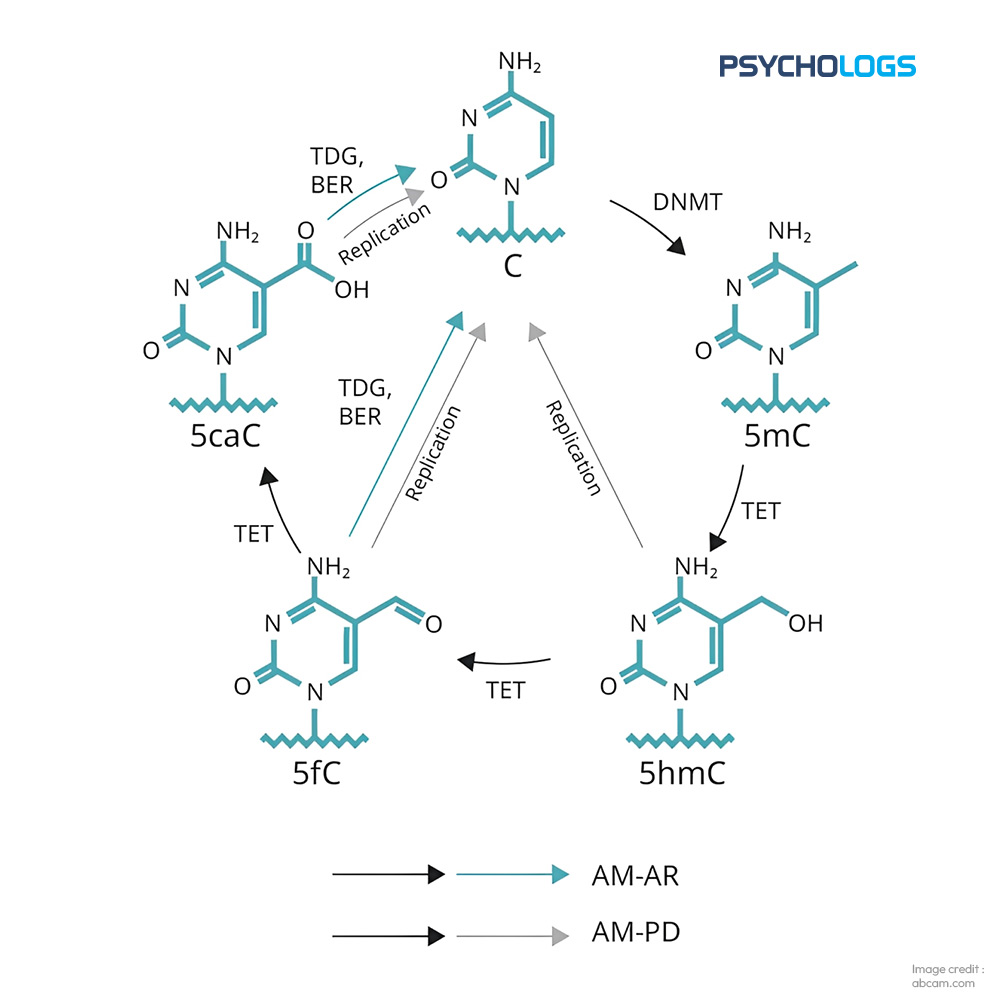
A genome contains a blueprint of all the instructions which is required for a living organism to grow; CpG dinucleotides are located nonrandomly in these genomes. CpG dinucleotides are concentrated at the CpG Islands(regions that consist of short DNA regions and high numbers of cytosines). DNA Methylation patterns can be built by DNA methyltransferases, which are certain proteins. The process of DNA Methylation has been proven to be important during embryo development.
2. Histone Modifications
Histones are proteins around which the DNA winds itself.DNA is long in structure; hence, the cell packs it using proteins called histones. The capacity to regulate gene expression and to offer structural stability is provided by histones. There are four main types of histones: H2A, H2B, H3, and H4. Researchers call the process in which DNA winds around the histone nucleosome formation.
Within these nucleosomes, there are core histones, which contain a globular domain. Histones have tails, and cells attach small chemical markers. The function of these marks is to act as sticky notes that tell the cell to either read the gene or ignore it. There are two types of chemical tags: the first being an active tag, which loosens the DNA thread, and the cell can then read the genes. The second is an inactive tags, which lock the genes so the cell cannot read them. The bimodal state represents where the gene receives both active and inactive tags at the same time.
3. Regulatory ncRNAs
Cells copy almost all the DNA to RNA; however, only a small part of it becomes protein (3%). The rest becomes non-coding RNA. The important function of ncRNA is flipping the genes on or off without altering the DNA.
ncRNA is non-coding RNA that is transcribed from DNA but not translated into protein. It is a functional RNA molecule, and it plays an important role in the epigenetic regulation of gene expression. The regulation of ncRNA is important because it allows the regulation of gene expression at various levels. ncRNA plays an important role during the developmental process. Females inherit two X chromosomes. It will lead to toxic products if there are double doses of X-gene chromosomes. ncRNA plays a role by coating one X chromosome. This ensures balance(Inbar-Feigenberg et al.,2013).
Read More: Understanding Parkinson’s Disease: Symptoms, Science, and Management
Epigenetics and Psychological Disorders
Contemporary studies have linked epigenetics and psychological disorders. Research in epigenetics has shown new directions in the understanding of these disorders, their occurrence and comorbidity. The impact of epigenetic processes is important in the fields of neurology and psychiatry. Alzheimer’s, Parkinson’s, and Huntington’s diseases are neurological diseases; epigenetic processes impact the onset and progression of these diseases.

Epigenetic changes play an important role in the risk of disease in psychiatric disorders such as depression, schizophrenia, and bipolar disorder. As research advances, researchers estimate that shared pathways of epigenetic processes contribute to the occurrence of neurological and psychological disorders.
Epigenetics becomes important to understand the role played by genes, environment and epigenetics. Neurotransmitter systems and stress response changes due to epigenetic changes in genes in patients with depression. Researchers have observed the mechanism of DNA methylation in genes involved in neural development in schizophrenia. They have identified changes in epigenetic markers in bipolar disorder and have detected unusual DNA methylation in Autism Spectrum Disorder (ASD) (Grezenko et al., 2023).
Epigenetics and Clinical Implications
Epigenetics helps in understanding how psychological disorders can manifest in individuals; it provides a biological lens. When clinicians make use of epigenetic reports, it helps to understand unique individual diagnoses and treatment plans.
1. Diagnosis
Understanding the mechanisms of epigenetics can help clinicians to diagnose psychiatric and neurological conditions. For different conditions, epigenetic modifications serve as biomarkers. This enables the right diagnosis. Epigenetics becomes impactful because it can detect epigenetic alterations before the complete onset of symptoms. Epigenetics gives a personalised approach to patients. Epigenetic profiling provides a clear picture of an individual’s genes and environment. This Profiling provides a clear picture of understanding of the disease risk and progression. Personalised diagnosis is beneficial because it treats disease as a complex factor shaped by the interplay of genes and environment.
2. Treatment
Epigenetics is rapidly shifting the treatment models by making treatment more personalised. This shift shows up in targeted therapies, personalised treatment plans, and combination therapies. Essentially, targeted therapies utilise the reversible nature of epigenetic changes; this aims at intervention at specific modification which are responsible for disease symptoms. The precision medicine approach has been promising in the treatment of depression and schizophrenia with intervention targeting certain epigenetic alterations. By understanding each individual’s unique epigenetic makeup, clinicians can devise personalised treatment plans(Grezenko et al.,2023).
Read More: Understanding Dopamine: From Reward Pathways to Neurological Disorders
Conclusion
Epigenetics, though a young field to study, has contributed a lot to the understanding of genetic processes and human behaviour. Epigenetics is the process where the DNA Sequence remains the same, but there are changes in gene expression. The core process which contribute to epigenetics are: DNA methylation, Histone Modifications, and regulatory ncRNA. Epigenetics has also contributed to the understanding of neurological and psychological disorders. Understanding the individual’s unique epigenetic profile can help clinicians to plan specific and early treatment outcomes.
References +
- MedlinePlus Genetics. (2024, May 21). What is a gene? U.S. National Library of Medicine. https://medlineplus.gov/genetics/understanding/basics/gene/
- MedlinePlus Genetics. (2021, January 19). What is DNA? U.S. National Library of Medicine. https://medlineplus.gov/genetics/understanding/basics/dna/
- MedlinePlus Genetics. (2021, January 19). What is a chromosome? U.S. National Library of Medicine. https://medlineplus.gov/genetics/understanding/basics/chromosome
- Felsenfeld G. (2014). A brief history of epigenetics. Cold Spring Harbour Perspectives in Biology, 6(1), a018200. https://doi.org/10.1101/cshperspect.a018200
- Weinhold B. (2006). Epigenetics: the science of change. Environmental health perspectives, 114(3), A160–A167. https://doi.org/10.1289/ehp.114-a160
- Inbar-Feigenberg, M. (2013). Basic concepts of epigenetics. Fertility and Sterility, 100(3), 703–708. https://doi.org/10.1016/j.fertnstert.2013.06.004
- Grezenko, H., Ekhator, C., Nwabugwu, N. U., Ganga, H., Affaf, M., Abdelaziz, A. M., Rehman, A., Shehryar, A., Abbasi, F. A., Bellegarde, S. B., & Khaliq, A. S. (2023). Epigenetics in Neurological and Psychiatric Disorders: A Comprehensive Review of Current Understanding and Future Perspectives. Cureus, 15(8), e43960. https://doi.org/10.7759/cureus.43960