

Our emotions are complex psychological phenomena involving many physical and mental changes. They are integral components of human life because they significantly affect our choices and actions. Our emotions assist us in comprehending the world around us, too. They guide our actions and colour our life experiences. An important question that arises is what causes emotions, and how they play out. Is it something we feel in the mind first, and then the body responds to it, or does the body play a major role?
The earliest theory regarding emotions is the Common Sense Theory, which provides the most intuitive explanation that emotions come first and the bodily reactions happen following the emotions. For instance, we see a snake, we feel fear because we are afraid, and then our body reacts, and our hearts start racing. This is a simple way of explaining how someone feels regularly. However, deeper inspection in this area led to questions regarding this notion. Newer concepts were proposed with an emphasis on the scientific perspective.
In the late 19th century, two prominent psychologists, William James and Carl Lange, came up with the theory that believed that we don’t react because we feel an emotion, but rather we feel an emotion because we react a certain way! This idea sparked a long debate in the field of psychology. Later in the 20th century, Stanley Schachter and Jerome Singer built upon this theory and showed how our interpretation of a situation and the context in which it occurs shapes emotions. These theories helped reshape the earlier ideas regarding our emotions.

The James-Lange Theory: Emotion Follows Bodily Change
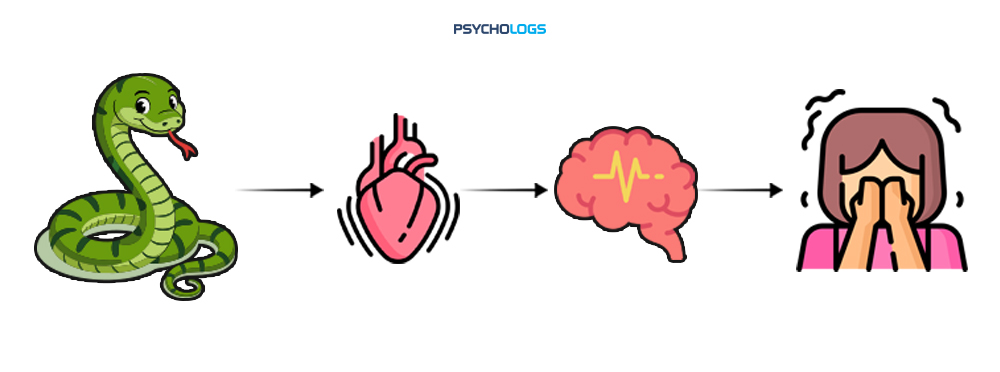
The James-Lange theory was revolutionary as it suggested that the body reacts first, and these bodily reactions are further interpreted by the mind. The sequence of these functions is
- Firstly, a stimulus is received by our senses.
- It is followed by a bodily response that acts as a cue.
- This further leads to an interpretation of the cue and experience of the emotion.
This model challenged the common-sense theory as it suggests that without the physiological reaction, there is no emotional experience.
Supporting Evidence
Some researchers have provided support for this model:
- Facial Feedback Hypothesis: It states that facial expressions can alter a person’s emotional experience. For instance, people instructed to smile frequently are reported to feel happier, which shows that bodily changes can affect our mood.
- Autonomic Patterns: Studies suggest that there are distinct physiological patterns for different emotions, suggesting that the body reacts in specific ways depending on the emotion.
Limitations of James-Lange theory
The James-Lange theory has notable limitations despite its historical significance.
- Firstly, a lot of emotions like fear, anger, and excitement have similar physiological responses. These overlapping physiological states raise the question of whether, if the bodily changes are not clearly different, they can cause differing emotions.
- Emotions often arise quicker than a full-body response. This raises questions regarding whether bodily changes truly cause emotions.
- Research shows that people with spinal injuries show emotions even with reduced physiological feedback. It shows that the body might help with the emotion, but it is not the sole source of it.
The Schachter-Singer Theory: Emotion Requires Arousal and Interpretation
Psychologists Stanley Schachter and Jerome Singer developed upon it and provided a more complex model. Their model was called “Two-factor theory of emotion”. They agreed that physiological arousal is important, but how we interpret that arousal is also important for the labelling of the emotion. According to their model, the sequence goes like:
- A stimulus is received by our senses.
- The physical arousal occurs with a simultaneous labelling of it.
- This eventually leads to the emotion.
For instance, if your heart is racing, you first interpret why your heart is racing based on a situation, then your brain labels it as joy or anger.
Criticisms
Although the Schachter-Singer theory is influential, it also has its limitations and criticisms.
- Researchers have found difficulty in replicating the original findings with the same consistency.
- This theory over-relies on cognition. Emotions and their reactions can be observed in babies and animals as well, without any complex interpretation.
- Some emotions, like fear, often happen too quickly and instinctively to involve thoughtful labelling.
Despite these criticisms, the two-factor theory remains influential for highlighting the role of both body and mind in emotional experience.
Modern Perspectives on Emotions
These earlier theories provided the foundation for further developments in this area. Modern psychology has developed more integrated models of emotions in light of the complexity of human emotions. Some of these theories are:-
1. Appraisal theories
Researchers like Richard Lazarus have argued that emotions result from a personal evaluation or appraisal of an event. For example: A person might get angry when insulted, while another feels sad for the same insult. This shows that our emotions are based on how we interpret the stimulus.
2. Constructivist Theory
Lisa Feldman Barrett’s theory of constructed emotions posits that emotions are not fixed biological reactions but learned patterns that are shaped by culture and personal experience. Our brain provides us with emotional meaning on the basis of context, past experiences and our physiological signals.
3. Affective Neuroscience
This theory states that some emotions might be biologically hardwired. Neuroscientist Jaak Panksepp identified some basic emotions like fear, anger, and care rooted in the brain’s subcortical structures. These basic emotions are further influenced by context and higher-level processing. These models of emotion integrate body, brain and cognition in explaining how we feel emotion.
Are the older theories outdated in comparison to them?
The earlier theories lay the foundations and basics of understanding emotions. Hence, they are not outdated but foundational. They introduce critical ideas upon which the modern theories have developed. The emphasis on physiology in James-Lange theory influenced the research on the physical roots of emotions. Whereas, Schachter-Singer theories highlighter the importance of context and interpretation, on which the constructivist model and appraisal theory were built.
Conclusion
The study of emotions has developed from a simple common-sense theory to more complex and scientifically grounded explanations. The James-Lange theory set the ground for the development of common-sense theory by providing an alternative explanation. The Schachter-Singer theory explained how our interpretations shape how we feel. Both theories have limitations of their own, but remain foundational in the field of psychology. Modern theories are built upon their insights and show the complex interplay of physiological reaction, context and past experiences. Understanding our emotions can help us navigate them more skillfully in everyday life.
Read More from UPS Education
- The Role of the Prefrontal Cortex in Executive Functioning
- The Role of the Limbic System in Emotion and Behaviour
- Diathesis Stress Model: From Predisposition to Psychological Disorder
- Eysenck’s Personality Theory Explained: The Biological Basis of Human Behaviour
FAQs
1. What is the Common Sense Theory of emotion?
The Common Sense Theory suggests that we first feel an emotion, and then our body reacts to it. For example, you feel afraid, and then your heart races. This is the most intuitive way people typically understand emotions, but it lacks scientific evidence.
2. How does the James-Lange Theory differ from the Common Sense Theory?
The James-Lange Theory proposes the opposite order: we experience physiological changes (like a racing heart or trembling hands) first, and then interpret those changes as an emotion. So, you feel afraid because your heart is racing.
3. What is the main idea behind the Schachter-Singer Theory?
Also called the Two-Factor Theory, it states that emotion is the result of two components: physiological arousal and a cognitive label. In other words, we feel aroused, and then we interpret the situation to decide what emotion we’re feeling.
4. Can the same physiological response lead to different emotions?
Yes. According to the Schachter-Singer Theory, the same physical arousal (like a fast heartbeat) can be interpreted as fear, excitement, anger, or attraction, depending on the context and how we label the experience.
5. Are the James-Lange and Schachter-Singer theories still relevant today?
Yes. Though both have limitations, they remain foundational in emotion research. Modern theories often expand on or integrate their ideas, showing that emotions are shaped by a mix of body responses, brain activity, and interpretation.
6. What are Appraisal theories of Emotion?
Appraisal theories suggest that emotions are triggered by how we evaluate a situation. For example, whether we see a situation as threatening, manageable, or meaningful influences the type of emotion we feel.
7. What is the role of the brain in Modern Emotion Theories?
Modern neuroscience has shown that specific brain regions, like the amygdala and prefrontal cortex, are involved in emotional processing. Some theories also propose that the brain predicts and constructs emotions using past experiences, bodily cues, and context.
References +
- Yarwood, M. (n.d.). Schachter-Singer Two-Factor Theory. Pressbooks. https://psu.pb.unizin.org/psych425/chapter/schachter-singer-two-factor-theory/
- Reisenzein, R. (1983). The Schachter theory of emotion: Two decades later. Psychological Bulletin, 94(2), 239–264. https://doi.org/10.1037/0033-2909.94.2.239
- Yarwood, M. (n.d.). James-Lange theory. Pressbooks. https://psu.pb.unizin.org/psych425/chapter/james-lange-theory/
- Cannon, W. B. (1927). The James-Lange Theory of Emotions: A Critical Examination and an Alternative Theory. The American Journal of Psychology, 39(1/4), 106. https://doi.org/10.2307/1415404
- Moors, A. (2017). Appraisal theory of emotion. In Springer eBooks (pp. 1–9). https://doi.org/10.1007/978-3-319-28099-8_493-1
- https://psycnet.apa.org/record/1999- 04021-030
- Montag, C., & Davis, K. L. (2018). Affective Neuroscience Theory and Personality: An update. Personality Neuroscience, 1. https://doi.org/10.1017/pen.2018.10
- Barrett, L. F. (2016). The theory of constructed emotion: an active inference account of interoception and categorisation. Social Cognitive and Affective Neuroscience, nsw154. https://doi.org/10.1093/scan/nsw154