

Post-traumatic stress disorder (PTSD) was formally recognised by the American Psychiatric Association (APA) in 1980, but the suffering it describes is far older. For more than a century, doctors saw the same pattern of symptoms in soldiers and civilians and gave it different names, usually blaming weakness, exhaustion or poor character rather than the traumatic event itself (Friedman, 2022). This article traces how that understanding changed: from the “shell shock” and “war neurosis” of the World Wars, through the clinical and political pressures that produced the DSM-III diagnosis, to the revised criteria of DSM-5 and its 2022 text revision.
This history matters because it shapes how trauma is treated today. Where distress was once treated as a moral failing, modern psychology treats it as an injury with identifiable causes, symptoms and treatments, and the diagnostic criteria decide who is believed, who receives care and who qualifies for support. Understanding how those criteria were built, and why they keep being revised, explains both the progress made and the debates that remain.
Stress & Shell Shock
Although the APA formally recognised PTSD as a separate disorder only in 1980 (APA, 1980), doctors had documented its key symptoms as early as the nineteenth century. These symptoms appeared in civilians who experienced disasters, such as railway crashes, and in soldiers who fought in the American Civil War (National Library of Medicine, 2012). Civil War doctors did not see these men as traumatised. Doctors diagnosed soldiers with conditions such as nostalgia, melancholia, exhaustion and cardiac complaints. They used terms such as irritable heart, soldier’s heart and cardiac muscular exhaustion to describe these conditions.
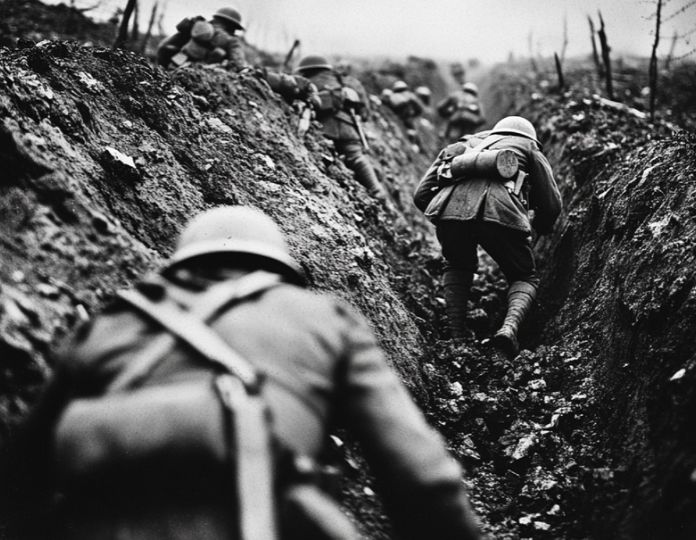
Physicians blamed heavy packs, too little time for recruits to adjust to army life, homesickness and unrealistic expectations of war. Psychological injury received little attention, partly because deaths from disease, infection and accidents dominated military medicine. A pattern was set that would recur for a century: the cause was sought in the soldier’s body or character rather than in what he had experienced. The First World War forced a rethink, though an incomplete one. In 1915, the psychologist Charles Myers used the term “shell shock” in The Lancet for soldiers who developed amnesia and sensory loss after exposure to exploding shells (Myers, 1915). The name implied a physical injury, a concussion or similar damage caused by blast.
That explanation soon failed, because many men with the same symptoms had never been near an explosion, and clinicians increasingly accepted that fear, horror and prolonged strain could produce the same picture (Jones & Wessely, 2005). The label nonetheless remained a catch-all for tremors, tics, fatigue, memory loss, sleeplessness, nightmares and poor concentration, many of which resemble the symptoms now linked to PTSD. Military authorities were uneasy about it, and by 1917 the British Army was discouraging its use in official records.
In the Second World War, doctors used a wider vocabulary, including exhaustion, battle exhaustion, combat fatigue, flying syndrome, war neurosis, cardiac neurosis and psychoneurosis. French and German writers had earlier described similar states as névrose de guerre and Kriegsneurose. These terms accepted a psychological origin, but they usually presented the problem as a temporary breakdown caused by accumulated strain, and they remained tied to the military setting. At the same time, researchers such as Abram Kardiner (1941) and Roy Grinker and John Spiegel (1945) described lasting symptoms, including exaggerated startle, irritability, nightmares and preoccupation with the event, and showed that even well-adjusted soldiers could break down under enough exposure.
It helps to separate three concepts that are often treated as one:
- Shell shock (First World War): Introduced as a physical injury caused by blast, then stretched to cover almost any wartime nervous breakdown. It was an informal label rather than a defined diagnosis, and it applied only to combat (Myers, 1915; Jones & Wessely, 2005).
- War neurosis and combat fatigue (First and Second World Wars): A psychological explanation replaced the physical one, but the condition was still understood as a reaction to exhaustion or cumulative strain, was expected to pass with rest and treatment near the front, and was often linked to the soldier’s predisposition (Grinker & Spiegel, 1945). Kardiner’s account of chronic traumatic neurosis was the main exception.
- PTSD (1980 onward): A formal diagnosis with defined criteria. It makes a specific traumatic event part of the definition, describes symptoms that persist beyond the event, assumes no special weakness in the sufferer, and is not limited to soldiers (APA, 1980).
The Evolution of PTSD
PTSD became widely known in popular culture because of the lasting effects of the Vietnam War, but each earlier war had produced its own term for the condition, among them soldier’s heart, shell shock and war neurosis. The diagnosis closely resembles the névrose de guerre and Kriegsneurose of the French and German literature. Descriptions of reactions to extreme stress in the ninth edition of the International Classification of Diseases were among the principles that shaped the first definition of PTSD in DSM-III (Turnbull, 1998). The path through the DSM was not straight. DSM-I (1952), published during the Korean War, included “gross stress reaction,” a transient response to severe physical or emotional stress that could develop into a chronic neurotic reaction in people with predisposing personality traits.
The DSM-II (1968) removed this category entirely, leaving it out of the manual despite the United States’ deep involvement in the Vietnam War at the time. As troops returned, veterans and sympathetic psychiatrists such as Robert Jay Lifton (1973) argued that their symptoms were a normal response to abnormal events rather than a sign of defective character. By the mid-1970s, as researchers proposed including PTSD in the third edition of the DSM, the devastating effects of the Vietnam War strengthened the case for recognising it as a distinct clinical condition (Turnbull, 1998). Combat was never the whole story. During the 1970s, clinicians working with civilians were describing the same pattern.

In 1974, Ann Burgess and Lynda Holmstrom documented “rape trauma syndrome” in women treated at a Boston hospital, finding fear, intrusive memories, sleep disturbance and avoidance that could persist long after the assault (Burgess & Holmstrom, 1974). Work on child abuse, domestic violence, Holocaust survivors and communities devastated by disasters, such as the 1972 Buffalo Creek flood in West Virginia (Erikson, 1976), pointed the same way. Judith Herman (1992) later argued that two social movements forced psychiatry to take trauma seriously: the anti-war movement, which made combat trauma visible, and the women’s movement, which did the same for sexual and domestic violence.
Later research confirmed how common the response is after sexual violence: in one prospective study, 94% of rape victims met the symptom criteria for PTSD within about two weeks of the assault, and 47% still did three months later (Rothbaum et al., 1992). When DSM-III introduced the diagnosis, it covered extreme events that fell outside ordinary human experiences. These included war, torture, rape, the Nazi Holocaust, the atomic bombings of Hiroshima and Nagasaki, natural disasters such as earthquakes, hurricanes and volcanic eruptions, and human-made disasters such as factory explosions, plane crashes and car accidents.
Experts considered these traumatic events different from everyday stressors such as divorce, failure, rejection, serious illness, or financial difficulties. They classified negative reactions to such stressors as adjustment disorders. Researchers later revised the diagnostic criteria in DSM-III-R (1987), DSM-IV (1994), and DSM-IV-TR (2000). The ICD-10 also describes a very similar condition. PTSD proved to be relatively common. Data from the National Comorbidity Survey Replication indicate that 3.6% of men and 9.7% of women in the United States experience PTSD at some point in their lives, a gap partly attributed to women’s greater exposure to sexual violence (Friedman, 2022; Tolin & Foa, 2006).
Rates are considerably higher in regions emerging from conflict: PTSD affects about 37% of people in Algeria, 28% in Cambodia, 16% in Ethiopia and 18% in Gaza (Friedman, 2022).
PTSD & DSM-5
Under DSM-IV, a diagnosis required exposure to a traumatic event involving actual or threatened death, serious injury or a threat to physical integrity, with a response of intense fear, helplessness or horror. The person also had to show symptoms from three clusters (intrusion, avoidance/numbing and hyperarousal) lasting more than one month and causing significant distress or impairment. DSM-5 (APA, 2013) made substantial, evidence-based revisions:
- Reclassification: PTSD moved out of the anxiety disorders into a new chapter, Trauma- and Stressor-Related Disorders. PTSD is not simply a fear-based anxiety disorder, as DSM-III and DSM-IV implied; many patients show anhedonic and dysphoric presentations, with negative thoughts and feelings and behaviours such as anger, impulsivity, recklessness and self-destructiveness (Friedman, 2022).
- A revised Criterion A: The requirement for an immediate emotional reaction of fear, helplessness or horror was dropped. Sexual violence is now named explicitly, and the ways of being exposed to a trauma are spelt out.
- Four clusters instead of three: A new cluster, negative alterations in cognition and mood, was added, and the arousal cluster now includes reckless or self-destructive behaviour.
- New specifiers: A dissociative subtype, a “delayed expression” specifier (full criteria not met until at least six months after the event), and separate criteria for children aged six and younger.
Criterion A: the traumatic event
A person must experience or encounter actual or threatened death, serious injury, or sexual violence in one of four ways: experiencing the event directly, witnessing it in person, learning that it happened to a close family member or friend through violence or an accident, or repeatedly encountering distressing details of the event as part of their work. The last applies mainly to people whose jobs involve this exposure, such as police officers or those who recover human remains. Watching traumatic events on television, in films, or in pictures does not count as qualifying exposure unless it is part of someone’s work. For example, watching news footage of the 9/11 attacks would not meet this criterion.
The four symptom clusters
- Intrusion (Criterion B; at least one symptom): The person relives the event through unwanted memories, nightmares, flashbacks (dissociative episodes in which the event feels as if it is happening again) and intense distress at reminders. Example: a car-crash survivor who relives the impact in nightmares and feels sudden panic at the sound of screeching brakes.
- Avoidance (Criterion C; at least one symptom): The person avoids memories, thoughts and feelings about the event, or the people, places and situations that recall it. Example: an assault survivor who takes a longer route to avoid the street where it happened and refuses to talk about it.
- Negative alterations in cognition and mood (Criterion D; at least two symptoms): Lasting changes in thinking and feeling, such as being unable to remember key parts of the event, persistent distorted beliefs (“I am broken,” “no one can be trusted”), blaming oneself or others, ongoing fear, guilt or shame, loss of interest, feeling detached from others and being unable to feel positive emotions. Example: a veteran who blames himself for a friend’s death, feels cut off from his family and no longer enjoys things he used to love.
- Arousal and reactivity (Criterion E; at least two symptoms): The person is constantly on edge, with irritability or angry outbursts, reckless or self-destructive behaviour, hypervigilance, an exaggerated startle response, poor concentration and disturbed sleep. Example: a disaster survivor who cannot sleep, jumps at sudden noises and snaps at family members. Hypervigilance and exaggerated startle help distinguish PTSD from panic disorder and generalised anxiety disorder, which share sleep and concentration problems (Friedman, 2022).
A diagnosis requires symptoms to last for more than one month and cause significant distress or interfere with work, relationships, or daily activities. Substance use or another medical condition must not explain these symptoms.
DSM-5-TR (2022)
The APA’s text revision, DSM-5-TR, kept the DSM-5 four-cluster structure and core criteria, refreshed the descriptive text with newer research, and added prolonged grief disorder to the Trauma- and Stressor-Related Disorders chapter (APA, 2022). This strengthened the view that PTSD is a response to adverse experiences rather than simply a fear-based anxiety disorder.
Conclusion
The history of PTSD reflects a long effort to recognise the impact of trauma on mental health. The terminology has changed repeatedly, from nostalgia, melancholia, soldier’s heart, shell shock and war neurosis to PTSD, yet the symptoms described are remarkably similar: intrusive thoughts, nightmares, negative emotions, avoidance, constant vigilance and difficulty concentrating.
For generations, people misunderstood or dismissed these symptoms, often blaming physical exhaustion, personal weakness, or an inability to cope with military life. The recognition that rape survivors, abused women and children, and disaster survivors showed the same pattern was just as important as the experience of soldiers in establishing that the cause lay in the event rather than the person. The inclusion of PTSD in DSM-III in 1980 was a milestone for psychiatry, showing that traumatic events can have a long-lasting effect on mental health.
Later editions, above all DSM-5 in 2013 and the 2022 text revision, reflect a broader understanding of the disorder, including changes in cognition, mood, behaviour and emotion rather than fear alone. Overall, the progression of PTSD highlights the importance of listening to those who suffer from it. Additionally, it emphasises the need for continued research and challenging traditional views in medicine. It supports the principle that psychological injuries deserve the same seriousness as physical ones.
Although diagnosis and understanding have advanced greatly, PTSD still affects people from every society, generation and background. Society can acknowledge the lasting effects of trauma and challenge the stigma around mental health difficulties. Additionally, it can widen access to treatment. In this way, society can respond to people with PTSD in a more compassionate and informed way.
References +
- National Library of Medicine. (2012). History, Diagnostic Criteria, and Epidemiology. In www.ncbi.nlm.nih.gov. National Academies Press (US). https://www.ncbi.nlm.nih.gov/books/NBK201095
- Turnbull, G. J. (1998). A review of post-traumatic stress disorder. Part I: Historical development and classification. Injury, 29(2), 87–91. https://doi.org/10.1016/S0020-1383(97)00131-9. History.com Editors. (2017, October 2). PTSD and Shell Shock. History. https://www.history.com/articles/history-of-ptsd-and-shell-shock
- Crocq, M.-A., & Crocq, L. (2000). From shell shock and war neurosis to posttraumatic stress disorder: A history of psychotraumatology. Posttraumatic Stress Disorder, 2(1), 47–55. https://doi.org/10.31887/dcns.2000.2.1/macrocq
- Finch, J. (2017, August 4). The history of the diagnosis of PTSD. Psychpd. https://psychpd.com.au/history-diagnosis-ptsd/
- Friedman, M. (2025). History of PTSD in veterans: Civil war to DSM-5 – PTSD: National centre for PTSD. Va.Gov; U.S. Department of Veterans Affairs. https://www.ptsd.va.gov/understand/what/history_ptsd.asp