
When meditating, do you feel completely tranquil? At prayer, do you get a sense of connection with a power greater than yourself, or do you experience a moment when your ordinary worries disappear? Whatever else these experiences might be spiritual, religious, meditative, or a deep psychological state you’ve probably wondered how they appear to the mind, and what sort of brain activity underlies such sensations.
“Neurotheology”, also known as “spiritual neuroscience,” is the scientific study of how the brain interacts with these religious and spiritual activities and behaviours. Its main aim is not to ask about the ‘literal and absolute truth’ of the beliefs or experiences, but instead the aim of “exploring in the brain what occurs while persons observe God, express spirituality, or feel the transcendent (Newberg 2014; Shukla et al., 2013).
This emerging area is particularly relevant today as meditation apps, mindfulness practices, psychedelic research, and discussions about mental well-being bring altered states of consciousness into our everyday lives.
What Is Neurotheology?
Neurotheology is an interdisciplinary field situated at the intersection of neuroscience, psychology, philosophy, religious studies, and theology. Instead of questioning ‘Does God really exist?’ -a question that modern technologies cannot address neurotheologists directly consider a significant question like ‘What happens in the brain when an individual experiences God, transcendence, prayer and spirituality?’ (Newberg 2014).
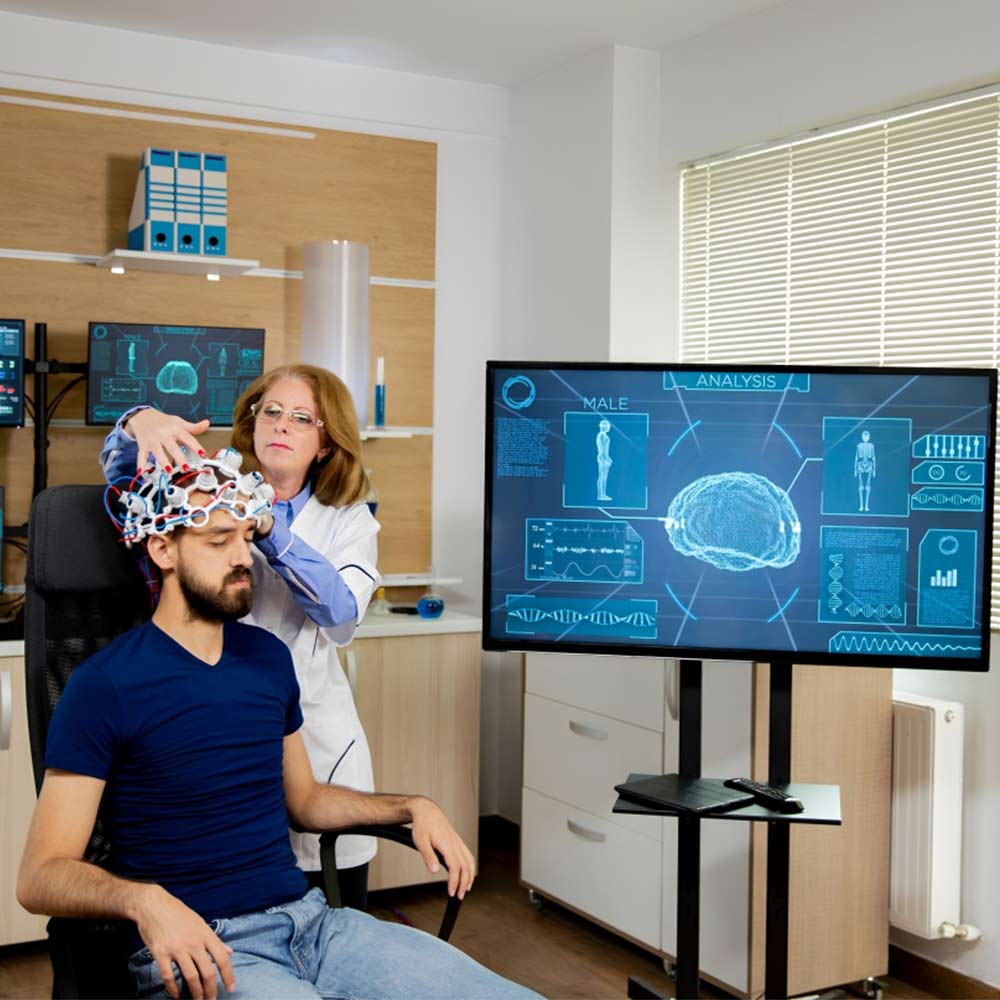
Researchers investigate spiritual experiences as subjective states that have measurable physiological and neural correlations. Brain imaging techniques have made it possible to examine changes in neural activity while people engage in practices such as meditation or prayer. Typical research methodologies include:
- Functional magnetic resonance imaging (fMRI) assesses brain regions and how they engage/desist throughout different stages or mental functions.
- Positron emission tomography (PET) offers analyses of metabolic brain activity and neurochemical involvement through emission of positrons and gamma radiation.
- Single-photon emission computed tomography (SPECT) uses a radioactive tracer to measure blood flow throughout the brain regions.
- Electroencephalography (EEG) can measure electrical activity from brainwaves and record alterations in neural rhythms.
- Psychophysiological measures of body functions such as skin resistance, pulse, respiration, and skin conductance can display emotional/physiological reactions during different mental states.
- Self-report measures are used to obtain qualitative perceptions of experiences to gauge their uniqueness and intensity (Newberg, 2014).
Neuro-researchers started to consider distinct areas that work with different mental, emotional and sensory data; spiritual experience probably does not rely on only one specific ‘God spot’ in the mind. Instead, these experiences involve interconnected neuronal activity in areas accountable for attention management, self-processing, social cognition, cognition, memory functions of the self, and perception (Jedlicka and Havenith 2025, Schjoedt 2009).
Meditation, Prayer, and the Brain
Meditation provides one of the most extensively studied examples of a spiritual or contemplative practice. Different types of meditation rely on attention, concentration, imagery, a range of thoughts about one’s body, emotional management, and self-monitoring. A recent quantitative meta-analysis found that meditation is associated with activity involving regions such as the insula, hippocampus, superior temporal gyrus, supplementary motor areas, and Rolandic operculum, although patterns may vary across meditation techniques (Baten et al., 2026).

Previous reports have additionally exhibited altered cerebral blood circulation caused by prayer and meditation. One brief examination of Franciscan nuns using meditative prayer found higher blood circulation within the prefrontal cortex, inferior frontal cortex, and the parietal areas (Newberg et al., 2003).
These findings can help explain why contemplative practices may influence psychological functioning. Attention regulation, emotional processing, repetitive verbal focus, and changes in self-referential thinking can all contribute to subjective feelings of calmness or connection.
However, the presence of neural activity does not demonstrate that spirituality is merely a neurological phenomenon. Every conscious experience such as love, music, grief, and mathematical reasoning has neural correlations. Identifying those correlations explains how an experience occurs, but not necessarily what the experience ultimately means to an individual.
Mystical Experiences & Altered States of Consciousness
Mystical experiences are often described using themes such as:
- A sense of unity or interconnectedness
- Reduced awareness of the ordinary self
- Altered perception of time and space
- A feeling of profound meaning or significance
- Intense positive emotions
- A perceived encounter with a transcendent reality
Neuroscientific models suggest that such experiences may involve changes in networks associated with self-referential processing and multisensory integration. The default mode network (DMN), which is involved in processes such as autobiographical memory and self-related thought, has attracted particular attention. Research on psychedelic states has found substantial disruption of normal DMN connectivity and increased communication between networks that are ordinarily more segregated (Gattuso et al., 2023).
Psychedelic research provides another window into altered consciousness. Controlled studies of substances such as psilocybin have reported substantial changes in functional connectivity across the brain, including networks involved in self-processing.
In one study, reduced coupling between medial prefrontal and posterior cingulate regions was associated with subjective experiences of “ego dissolution” during psilocybin-assisted mindfulness practice (Smigielski et al., 2019). These findings are scientifically significant because they demonstrate that profound changes in the sense of self can accompany measurable changes in large-scale brain networks.
However, a neural explanation does not automatically determine the metaphysical interpretation of the experience. A person may interpret ego dissolution as union with the universe, a religious revelation, psychological transformation, or an unusual brain state. Neuroscience can investigate the mechanisms associated with the experience; it cannot independently establish which interpretation is ultimately correct.
What Neuroscience Can Tell Us & What Not
Neurotheology becomes more helpful when researchers differentiate between neural explanation and philosophical interpretation. Neuroscience may help in explaining:
- Which brain networks become more or less active during prayer and meditation.
- How attention, emotion, memory, and self-processing contribute to spiritual experiences.
- How altered states of consciousness change functional connectivity.
- Why neurological conditions can sometimes produce unusual religious experiences.
- How contemplative practices may influence cognition and psychological well-being (Jedlicka & Havenith, 2025).
Neuroscience, itself, may not establish:
- Whether God or another transcendent reality exists.
- Whether a mystical experience is objectively supernatural.
- Whether spirituality is ultimately reducible to brain activity.
- Whether a particular religious interpretation of an experience is true or false.
- Whether neural correlates are causes, consequences, or merely accompanying features of an experience.
This distinction is crucial because correlation does not settle questions of meaning or metaphysics. The discovery that prayer changes brain activity is no more proof that prayer is supernatural than the discovery that music changes brain activity proves that music is “nothing more than neurons.” Such conclusions exceed what the method can establish (Newberg, 2014; Jedlicka & Havenith, 2025).
Major Debates in Neurotheology
One major area of contention is reductionism. A strict reductionist view might suggest that all spiritual phenomena are merely caused by neural mechanisms. On the other hand, critics of this perspective argue that it fails to account for the contributions of culture, personal history, social interaction, religious traditions, and subjective meaning (Jedlicka & Havenith, 2025). Modern researchers are increasingly embracing a multi-layered explanation of such phenomena based on biological, psychological, social, and cultural factors.
Another central issue in the field is the correlation between spirituality and neurological disorders. Certain conditions, such as temporal-lobe epilepsy, have been historically associated with the manifestation of intense religious visions, ecstasy, and heightened beliefs.
However, the scientific literature has demonstrated this is a phenomenon seen only in a fraction of those suffering from epilepsy; therefore, the idea of a specific region of the brain responsible for religious experience is likely premature and oversimplified (Saver & Rabin, 1997; Devinsky & Lai, 2008).
A broader and newer theoretical framework currently gaining attention is what is called predictive processing, where researchers hypothesise that the brain continually anticipates events and the content of people’s experiences, updates its expectations based on sensory information, and produces predictions about what’s to come. Viewed this way, one explanation for religious experiences is that they result from a confluence of prediction, perception, emotion, and experience (Schjoedt et al., 2017). This does not necessarily invalidate spiritual interpretations; instead, it offers one possible account of how the brain constructs conscious experience.
Ethical Considerations
Ethical considerations in neurotheology are crucial since spirituality plays a significant role in self-identity, values, community, and purpose. Researchers must take great care not to pathologise individuals’ beliefs based solely on their religious/spiritual experiences with detectable neurological correlations. Seven key ethical principles for neurotheology include:
- Respect for all religious/non-religious beliefs such as religious, spiritual, agnostic, atheist, and theistic on an equal footing in research (Farah, 2008, 2012).
- A guarantee of full informed consent when using brain imaging, including what can be learned about an individual, the limitations of technology, etc.
- Privacy of mental life, as data collected from a brain could be highly sensitive.
- Avoidance of exaggerated scientific language claiming ‘proven’ or ‘disproven’ the existence of God.
- Cultural sensitivity, since religions use various methods for spiritual experience like prayer, meditation, ecstatic states, etc.
- Mental-health professionals should neither impose religious beliefs on clients nor dismiss meaningful spiritual beliefs without adequate justification (Puchalski, 2009).
Given the continuing advancements in neurotechnology, these principles are increasingly important when considering not just spirituality, but also autonomy, identity, and moral responsibility (National Institutes of Health, 2026).
Conclusion
Neurotheology offers a fascinating opportunity to bring two traditionally different ways to understand human experience within one conversation. Neuroscience continues to examine the process of neural mechanisms underlying meditation, prayer, religious or mystical experiences, psychedelic states, and brain disease or disorder. These investigations promise further light into how the networks that involve people sustain attention, emotional regulation, and self-awareness. They also help to understand how attention, emotion, awareness of self, and senses were altered by religious or mystical/psychedelic and brain-related experiences.
Nonetheless, these findings should not be considered as having conclusively demonstrated or disproven the existence of Gods, the origins of consciousness, or the ultimate purpose or goal of any religion. Spirituality is not solely about changes in neuronal networks. People’s experiences of the divine or ultimate reality involve much more than changes in their nervous and hormonal systems. A person’s psychological disposition can shape how they understand such experiences. Their social and cultural background, expectations, relationship status, and family upbringing can also influence their spiritual experiences. Cultural influences and personal expectations further affect how individuals interpret and experience spirituality (Newberg, 2014; Jedlicka & Havenith, 2025).
The richest frontier for neurotheology may lie in the ability of different disciplines to formulate better questions about shared human mysteries. It is not about trying to replace one type of explanation with another. Brain scans and laboratory tools help us understand how the physical brain works. However, science must remember that a human being is much more than just a biological machine.
References +
- Saver, J. L., & Rabin, J. (1997). The neural substrates of religious experience. The Journal of Neuropsychiatry and Clinical Neurosciences, 9(3), 498–510.
- Newberg, A., Pourdehnad, M., Alavi, A., & d’Aquili, E. G. (2003). Cerebral blood flow during meditative prayer: Preliminary findings and methodological issues. Perceptual and Motor Skills, 97(2), 625–630.
- Devinsky, O., & Lai, G. (2008). Spirituality and religion in epilepsy. Epilepsy & Behaviour, 12(4), 636–643.
- Puchalski, C. M. (2009). Physicians and patients’ spirituality: Ethical concerns and boundaries in spirituality and health. AMA Journal of Ethics, 11(10).
- Schjoedt, U., Stødkilde-Jørgensen, H., Geertz, A. W., & Roepstorff, A. (2009). Highly religious participants recruit areas of social cognition in personal prayer. Social Cognitive and Affective Neuroscience, 4(2), 199–207.
- Farah, M. J. (2012). Neuroethics: The ethical, legal, and societal impact of neuroscience. Annual Review of Psychology, 63, 571–591.
- Newberg, A. B. (2014). The neuroscientific study of spiritual practices. Frontiers in Psychology, 5, 215.
- Schjoedt, U., Sørensen, J., Nielbo, K. L., Xygalatas, D., Mitkidis, P., & Bulbulia, J. (2017). Cognitive resource depletion in religious rituals. Religion, Brain & Behaviour, 7(2), 82–98.
- Smigielski, L., Kometer, M., Scheidegger, M., Krähenmann, R., Huber, T., & Vollenweider, F. X. (2019). Psilocybin-assisted mindfulness training modulates self-consciousness and brain default mode network connectivity with lasting effects. NeuroImage, 196, 207–215.
- Gattuso, J. J., Perkins, D., Ruffell, S., Lawrence, A. J., Hoyer, D., Jacobson, L. H., Timmermann, C., Castle, D., Rossell, S. L., Downey, L. A., Pagni, B. A., Galvão-Coelho, N. L., Nutt, D., & Sarris, J. (2023). Default mode network modulation by psychedelics: A systematic review. International Journal of Neuropsychopharmacology, 26(3), 155–188.
- Jedlicka, P., & Havenith, M. N. (2025). Religious and spiritual experiences from a neuroscientific and complex systems perspective. Neuroscience & Biobehavioral Reviews, 177, 106319.
- Baten, C., Keller, A. S., Miller, C. H., & Sacchet, M. D. (2026). The functional neuroimaging of meditation: A quantitative whole-brain meta-analysis and systematic review. Neuroscience & Biobehavioral Reviews, 186, 106709.