
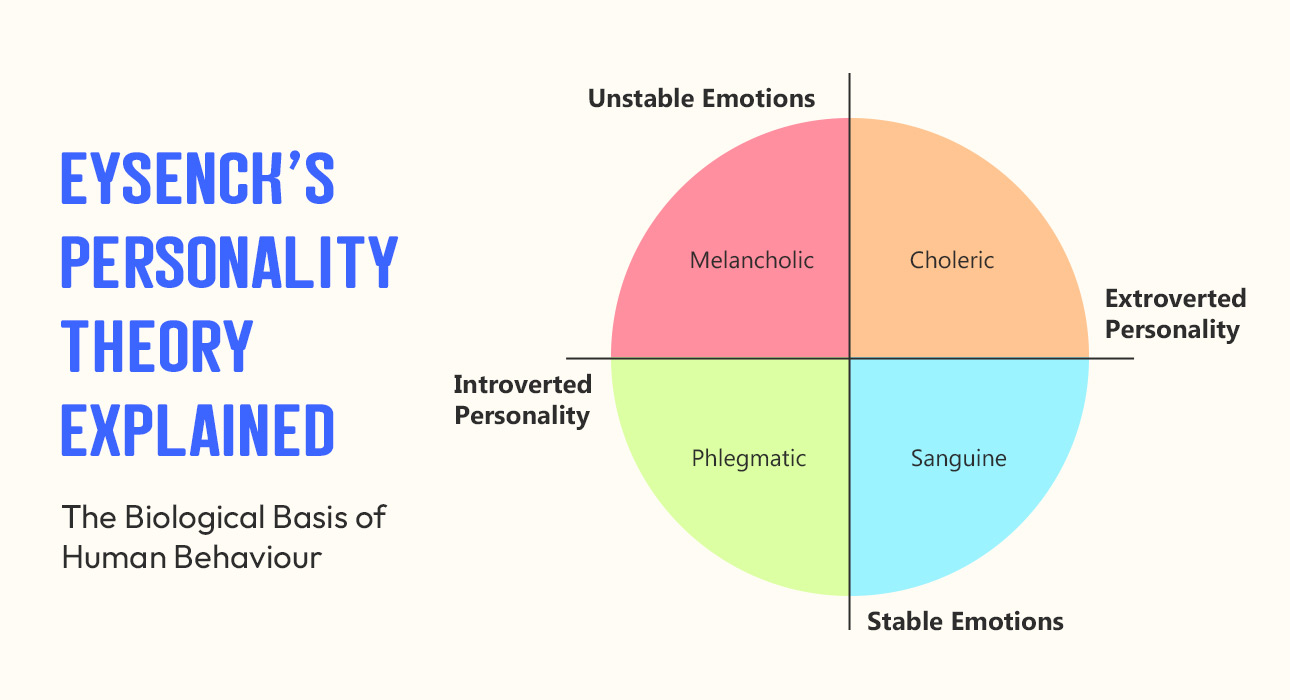
For decades, psychologists dominated the field with environmental theories that saw the human mind as a blank slate. Hans J. Eysenck, however, questioned this logic and argued that personality stems from biology and genetics (Eysenck, 1967). His Personality theory proposes that our patterns of behaviour are not learned habits at all, but represent the outward manifestations of our specific neurological wiring.
Imagine standing in a big room full of people. For some, the noise and energy feel like a necessary fuel. For others, it feels like an overwhelming wave that demands a quiet exit. Why do we react so differently to the same environment? The answer isn’t just in our minds; it is in our DNA, Hans Eysenck argues. Eysenck changed the landscape of psychology by insisting that our character is wired into our nervous systems. He thought that our behaviour is a consequence of how our brains process stimulation.
Read More: Attribution Theory Explained: How We Interpret Behaviour and Make Judgments
The Foundation: Personality as a Biological Organisation
Eysenck made a paradigm, defining a contribution to this field by positing that personality is an organised, stable, physical entity that determines how we interact with our environments. He turned away from the concept of “subconscious” and concentrated instead on measurable, physiological differences. These definitions, according to him, lie at the heart of his theory.
“Personality is the more or less stable and enduring organisation of a person’s character, temperament, intellect, and physique, which determines his unique adjustment to the environment” (Eysenck, 1970, p. 2). That definition stresses that personality is “enduring”; it doesn’t move with the weather. A “physique,” rather than a personality type, is part of the body’s innate DNA; this part filters every experience one has
The Hierarchy: From Moments to Maps
Personality isn’t a land of flats; it’s a pyramid. Eysenck developed a Hierarchical Model for how little actions come together and form lifelong traits (Eysenck, 1967). At the bottom are Specific Responses. Buying a stranger a coffee once. It’s a moment. Above it are Habitual Responses. Buying that coffee every Tuesday. It’s a pattern. With these habits together come Traits, such as sociability. And last of all, up at the top, are the Superfactors, the broad, biological dimensions that determine who an individual is.
- Level 1 (The Moment): A Specific Response (a single laugh).
- Level 2: A Habitual Response (laughing often).
- Level 3: A Trait (being sociable).
- Level 4 (The Map): The Type (Extraversion).
This model fosters a scientific, factor-based approach to the assessment of human differences (Revelle, 2016).
The PEN Model: Three Wires That Define You
Eysenck developed three dimensions of personality. He called it the PEN model. It was not an enumeration of adjectives, but a map of neurological sensitivity.
1. Extraversion (E)
For Eysenck, being an extrovert wasn’t about being “friendly.” It was about the Ascending Reticular Activating System (ARAS) (A network of neurons in the brainstem that regulates overall brain arousal and alertness). This is the brain’s dimmer switch for arousal.
- Extraverts have a lower baseline arousal: Their brains are inherently “quiet” or under-stimulated. To feel “normal,” they must search for noise, social tension, and risk. They respond to stimulation because their biology is bored (Eysenck, 1967).
- Introverts have very high baseline arousal: Their brains are already “vibrating” at a high frequency. In their eyes, a quiet room is a concert. When they attend a loud party, they aren’t “shy”; they are literally being over-stimulated. They retreat to preserve physiological balance.
- The Biological Switch: Hedonic Tone. Central to this dimension is a biological switch we call Hedonic Tone(The “pleasure setting” that tells us how much stimulation we need to feel comfortable). Eysenck (1967) argued that everyone finds their own optimum level of stimulation. Introverts have very high endogenous arousal, and their switch to “overloaded” flips very quickly. On the other hand, Extraverts require a much higher input of external stimulus to fully experience the peak of their pleasure (Geen, 1984).
2. Neuroticism (N)
The N-dimension is related to the Limbic System( The part of the brain that manages emotions and stress responses) and the autonomic nervous system (ANS)( The part of the nervous system that controls involuntary bodily functions like heart rate, digestion, and stress responses)
Those with high levels of Neuroticism have a lower threshold for activation in the “fight-or-flight” centre of the brain (Eysenck, 1967). According to Eysenck and Eysenck (1985), these individuals are more reactive to stress and take far longer to return to a baseline emotional state post-disturbance. This biological sensitivity appears as anxiety, moodiness, or irritability. On the contrary, stable individuals have a resilient ANS that remains calm under pressure (Matthews & Gilliland, 1999).
As Eysenck (1967) pointed out, it is not “weakness” but a sign of a highly reactive sympathetic nervous system( The body’s “fight or flight” response system that activates during stress). This physiological response presents itself as:
- Emotional Lability: Frequent shifts in mood (Eysenck, 1970).
- Somatic Complaints: Physical symptoms like tension headaches or digestive issues caused by prolonged ANS activation (Zuckerman, 2005).
- Anxiety and Vigilance: A constant state of “readiness” for potential threats in the environment.
3. Psychoticism (P)
Psychoticism (P) includes traits such as coldness, impulsivity, and lack of empathy. More importantly, a high score on Psychoticism is not indicative of a clinical psychotic disorder. Rather, it mirrors a personality style driven by biological determinants, like hormones (e.g., higher testosterone) and brain chemistry (e.g., low monoamine oxidase or MAO-A, a chemical in the brain that affects mood and behaviour)
Individuals high in Psychoticism may exhibit antisocial behaviour, such as being tough-minded and non-conformist or, indeed, troublesome socially. But it’s often associated with positive traits such as creativity. Eysenck claimed that high Psychoticism can promote “over-inclusive thinking,” enabling people to make connections that are not otherwise obvious, which is an essential component of creative genius. So, Psychoticism ranges from socially challenging behaviours to imaginative, divergent thought processes. Psychoticism in Eysenck’s model does not refer to a disorder, but rather biological personality traits that affect how a person thinks, feels and acts in everyday life.
Conditionability: Why We Listen to ‘No’
Why do some people follow the rules and others don’t?
- Introverts, due to high arousal, are “conditioned” more readily (Eysenck, 1981). They catch the “sting” of social disapproval faster. Their biology is responsive to it, so they learn the “voice of conscience” early.
- Extraverts, because their arousal tends to be low, are also more difficult to condition. They are less sensitive to “punishment” from their society, which Eysenck employed to justify why some people are more naturally rebellious. Biology determines how quickly a social lesson takes place.
Read More: 6 Reasons You Should Study Psychology
The Criminal Mind: High PEN and the Law
Eysenck (1977) was among the first to incorporate a purely biological model in forensic psychology. He noted that the “typical” offender scores high on all three of these PEN dimensions. High Extraversion leads to them feeling like thrill-seekers with a love of the crime’s “buzz,” high Neuroticism to an emotionally unstable person who can tend to act impulsively and react with extreme reactions, and high Psychoticism provides the coldness and lack of empathy for a victim (Eysenck & Gudjonsson, 1989). Extraverts are biologically harder to “condition,” which means they are less sensitive to the “sting” of social disapproval or the threat of prison. The biological need for stimulation, to them, overpowers the social lesson of the law.
Grey’s update: Sensitivity to Reward and Punishment
To get a proper view, let’s consider Jeffrey Grey (1970), the greatest Eysenck student. As an update to Eysenck’s work, Grey proposed the Reinforcement Sensitivity Theory (RST). He argued that personality isn’t just a question of “arousal,” but is ultimately about our reaction to rewards (BAS) and punishments (BIS). Viewed from this angle, Neuroticism is redefined as an intense reactivity to potential failure or “punishment” in the environment (Matthews & Gilliland, 1999).
The Legacy: Nature vs. Nurture
Eysenck was a radical. He postulated that 75% of personality is hereditary. This number is closer to 50 per cent in modern science, but his argument is valid in its own way: the environment is merely the “trigger” for a biological “gun” (Eysenck, 1991). If a person has the “Neuroticism” gene, having a stressful childhood could well set off an anxiety disorder. In a stable home, that gene may come out as deep empathy or artistic sensitivity. The biology is fixed; the environment is in charge of how it shows itself (Phenotypic Expression).
The Final Thoughts: “The Ghost in the Machine”
The personality theory of Eysenck marked a change in psychology by firmly establishing behaviour in biology. Abandoning the belief in a blank slate in the mind, he suggested that personality arises from inherited neurological systems that produce how we think, feel, and react to the world. In his hierarchical model, Eysenck showed us that small, momentary actions gradually organise into stable traits and together create broad personality types. His PEN model, Extraversion, Neuroticism, and Psychoticism, offered us a robust, biologically founded way to make sense of individual differences.
Importantly, Eysenck did not dismiss the environment but redefined its role. Life experiences do not create personality from nothing; instead, they interact with our biological predispositions, influencing how these traits are expressed. This perspective marries nature and nurture through personality, seeing personality as both genetic and environmental.
References +
Campbell, J. B., & Hawley, C. W. (1982). Study habits and Eysenck’s theory of extraversion and introversion. Journal of Research in Personality, 16(2), 139–146.
https://doi.org/10.1016/0092-6566(82)90070-8
Eysenck, H. J. (1967). The biological basis of personality. Charles C. Thomas. Eysenck, H. J. (1970). The structure of human personality (3rd ed.). Methuen. Eysenck, H. J. (1977). Crime and personality. Routledge & Kegan Paul.
Eysenck, H. J. (1981). A personality model. Springer-Verlag.
Eysenck, H. J. (1991). Dimensions of personality. Routledge.
Eysenck, H. J. (1992). The definition and measurement of psychoticism. Personality and Individual Differences, 13(7), 757–785. https://doi.org/10.1016/0191-8869(92)90050-2
Eysenck, H. J. (1995). Genius: The natural history of creativity. Cambridge University Press.
Eysenck, H. J. (1997). Personality and experimental psychology: The unification of psychology and the possibility of a paradigm. Journal of Personality and Social Psychology, 73(6), 1224– 1237. https://doi.org/10.1037/0022-3514.73.6.1224
Eysenck, H. J., & Eysenck, S. B. G. (1985). Personality and individual differences: A natural science approach. Plenum Press.
Eysenck, H. J., & Gudjonsson, G. H. (1989). The causes and cures of criminality. Plenum Press.
Geen, R. G. (1984). Preferred stimulation levels in introverts and extraverts: Effects on arousal and performance. Journal of Personality and Social Psychology, 46(6), 1303–1312. https://doi.org/10.1037/0022-3514.46.6.1303
Grey, J. A. (1970). The psychophysiological basis of introversion-extraversion. Behaviour Research and Therapy, 8(3), 249–266. https://doi.org/10.1016/0005-7967(70)90069-0
Matthews, G., & Gilliland, K. (1999). The personality theories of H. J. Eysenck and J. A. Grey: A comparative review. Personality and Individual Differences, 26(4), 583–626. https://doi.org/10.1016/S0191-8869(98)00158-5
Revelle, W. (2016). Hans Eysenck: Personality theorist. Personality and Individual Differences, 103, 32–39. https://doi.org/10.1016/j.paid.2016.04.039 Zuckerman, M. (2005). Psychobiology of personality (2nd ed.). Cambridge University Press.