

Identity is complex to define. In psychology, identity is a sense of self which is defined by unique characteristics which an individual possess which are not shared by any other individual. Identity is also defined by a set of affiliations and social roles. It also involves a sense of continuity, which means that one remains the same even after years. This is derived from one’s body image, the feeling of one’s memories, goals, values, expectations, and beliefs belonging to the self. This is known as Personal Identity (American Psychological Association, n.d.).
Identity becomes crucial as individuals reach adolescence. Adolescents become curious and want to know who they are. One of the explanations is that their intellectual abilities become adult-like. Adolescents become more aware of themselves due to puberty. They develop an understanding that they are different from their parents, peers and everyone else around them (Feldman, 2018). This article aims to understand how developmental psychology understands identity and identity formation, James Marcia’s approach to identity and other approaches given by developmental psychologists.
Identity According to Marcia
James Marcia is a developmental psychologist who is famously known for his theory on identity status. His work is inspired by Erik Erikson, who has given extensive literature on identity and identity development. Marcia, while explaining identity, takes a different approach as “identity as a self- structure, an internal, self-instructed, dynamic organisation of drives, abilities, beliefs, and individual history. Marcia advocates that the better the structure is, the more they are aware of themselves and vice versa. Identity structure is dynamic, which means that it changes over time.
Individuals continuously discard old values and beliefs and adopt new ones. Marcia emphasises that one of the most crucial periods for structural change in identity is adolescence. One of the important reasons is that adolescence marks a transitional change from concrete to formal operations, moral issues to human transcendence values, and psychosocial concerns that are from others’ expectations to one’s own unique organisation (Marcia,1980).
Identity Statuses
Erikson explained identity in psychosocial developmental stages, where he emphasised that identity development takes place in eight stages. An individual needs to resolve the conflict in each stage to progress towards the next stage. When an individual resolves the conflict, he experiences an outcome from it. Although Erikson explained the psychosocial stages, he did not explicitly mention how an individual can work to resolve the conflict. Marcia’s explanation of identity is based on ego structure and Erikson’s identity crisis stage of adolescence. The outcomes of the identity crisis are identity statuses. Adolescents aged 18 to 22 can be classified into four distinct identity statuses that cover different patterns of identity formation.

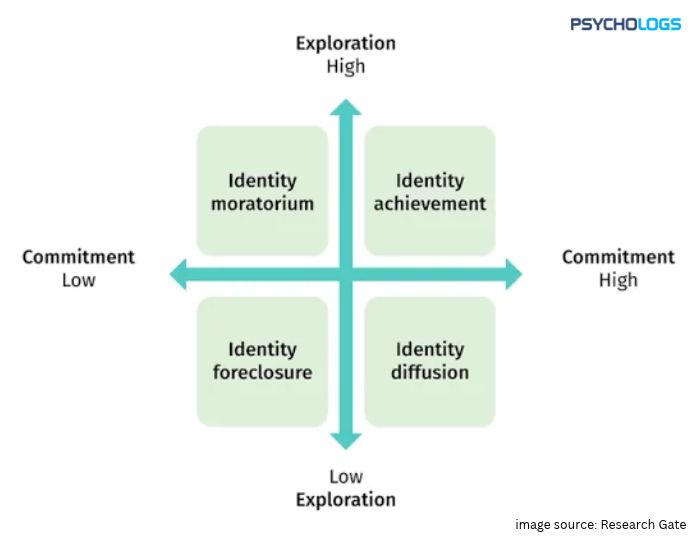
Marcia expanded Erikson’s theory and explained identity formation during adolescence as consisting of both exploration and commitment with respect to ideology and occupations. Identity starts developing when their role model presents options as to what they can become. As identity development proceeds, an individual needs to choose and commit to the options according to the social contexts. The four statuses are: Identity Diffusion, Identity Foreclosure, Identity Moratorium, Identity Achievement(Honness & Yardley, 2003).
Two Characteristics
The period in which an adolescent chooses to explore multiple options or alternatives consciously is termed crisis or exploration, whereas Commitment refers to psychological investment in a course of action and ideology. Identity statuses depend on the presence or absence of crisis and commitment (Feldman, 2018).
- Identity Diffusion : Identity diffusion refers to the status where the individual has neither explored the option nor they have committed to them. Marcia explains that when an individual enters this status, they have little awareness about their identity. Although it is common, adolescents are expected to move out of this stage and explore their options since they have a role model. Adolescents who do not move out of this stage tend to lack purpose in life and move aimlessly. For example : Students who have completed their 10th std are often found in this status, where they have their role model suggesting different options, but some students feel hesitant to explore and commit to the options.
- Identity Foreclosure: Adolescents have committed to an identity but have not explored the options. Younger adolescents often enter this phase where they are committed to an identity but have not explored the options. The commitment results from uncertainty, societal expectations and cultural norms. Although adolescents go beyond foreclosure, where they commit to the action and also explore the options, at times identity foreclosure will persist in later adolescence. The statues of identity foreclosure happens to take place when parents ask the teenagers to directly commit to the action rather than giving a chance to the teenagers. At times, teens follow the steps of their parents or significant others. For example: A student might not be allowed or given an opportunity to explore different career options; instead, the student is pressured to pursue engineering.
- Identity Moratorium: Identity moratorium is a status where the individual is actively exploring options but has not made a commitment to an option. This period brings anxiety and tension. The adolescent faces many questions but has no answers. This phase acts as a precursor to identity achievement. For example: A student who is exploring many career options actively but gets overwhelmed due to the wide available options. The student then becomes a bit anxious to understand and select the right option.
- Identity Achievement: The fourth and final phase is known as Identity Achievement because the individual explores various options and commits to the options. It is a long process because it takes time to explore many options and finally commit to one of them. For example: A student might have started searching for their career options since eighth grade and is now finally able to make a decision and commit to it (Marcia, 1980; Lumen Adolescent Development, 2023 ).
The Theoretical Significance of Identity Status Model
The identity status model is significantly valid under empirical testing. However, Psychologists and researchers have questioned whether the identity status model is a theory of identity development. This involves two related aspects. First, identity development involves moving from a lower identity status to a higher one. Second, it raises the question of whether individuals complete their identity development when they achieve identity status.
Waterman answers these aspects by explaining that the identity status model is not a theory of identity development, the primary reason being that Marcia has considered only two features: exploration and commitment. It also does not distinguish between the lower and higher identity statuses. Identity achievement does not mark the end of identity development, as individuals may change even their most carefully considered choices over time. Although the identity status model is not a theory of development, it is useful to understand the major transitional crisis faced by individuals on a day-to-day basis.
It is better understood as a two-dimensional model rather than a theory that explains identity development. What makes an Identity Status Model different from Developmental Stages is the notion that developmental stages follow a sequence, somewhat universal in nature. Examples of Developmental Stages include: Erikson’s psychosocial stages of development(1963), Psychosexual Stages of development(1905), Piaget’s sensorimotor stages of development(1952). On the other hand, the Identity Status Model refers to the phases that an individual experiences. Developmental Theories explain the growth and progress within individuals. Identity status keeps on changing as per the role an individual has to play(Meeus et al., 1992 ).
Criticism
Psychologists in the field argue that identity status may not be global because an individual may have different aspects of identity in different statuses. An individual may be in multiple identities in different statuses. For example: An individual might be in a moratorium phase for his religious identity, and in the foreclosure phase for his career identity. Identity status does not develop in systematic stages; rather, they progress.
For example: An individual who had reached the Identity Achievement phase might come to Identity Diffusion because maybe his plan did not work out(Lumen Adolescent Development, 2023). In spite of the criticism, James Marcia’s approach to understanding identity development has remained central in developmental psychology and research.
Case Snippet
Analyse the case given below. Identify the phase in which Alice is finding herself. If Alice went to her college counsellor how should the college counsellor respect her intersectionality and help Alice to resolve the conflict. Alice is a 20-year-old university student. She is academically bright and is a leader of the student council. Although it seems perfect, Alice constantly faces challenges with her social life and religious life.
She is unable to make new friends and tries to explore rather than commit to one friend. This causes instability in social relationships, and her friends do not rely more on her. She remains committed to her own faith but also wants to learn about other religions, although her parents do not support this. Alice feels pressured, left out, tense, and anxious. This creates problems in her day-to-day life.
Conclusion
James Marcia is a developmental psychologist who proposed and expanded Erikson’s theory of psychosocial stages of development. Marcia proposed his Model of Identity Status in the context of two important features: Exploration and Commitment. Marcia explained that there are four phases to it: Diffusion, Foreclosure, Moratorium, Achievement. Later, psychologists argued that the Identity Status Model cannot wholly explain identity development.
References +
- Marcia, J. E. (1980). Identity in adolescence. Handbook of adolescent psychology, 9(11), 159-187. https://onlinelibrary.wiley.com/doi/abs/10.1111/j.1532-7795.2010.00716.x
- American Psychological Association. (n.d.). Identity. In APA dictionary of psychology. Retrieved October 18, 2026, from https://dictionary.apa.org/identity
- Lumen Adolescent Development. (2023). Identity development theory. https://courses.lumenlearning.com/adolescent/chapter/identity-development-theory
- Honess, T., & Yardley, K. (Eds.). (2003). Self and identity: Perspectives across the lifespan. Routledge.https://books.google.co.in/books?hl=en&lr=&id=hGSQAgAAQBAJ&oi=fnd&pg=PA87&dq=james+marcia+identity+status+theory&ots=UvcINAshof&sig=uA4xXxmW7WhrNSqIhlVvxWB8-S4&redir_esc=y#v=onepage&q&f=false
- Meeus, W. (1992). Toward a psychosocial analysis of adolescent identity: An evaluation of the epigenetic theory (Erikson) and the identity status model (Marcia). In W. Meeus, M. de Goede, W. Kox, & K. Hurrelmann (Eds.), Adolescence, careers and cultures (pp. 55–76). De Gruyter. https://doi.org/10.1515/9783110886610-005
- Feldman, R. S., & Babu, N. (2018). Development across the lifespan (8th ed.). Pearson Education.