

Factor Analysis is a statistical technique that makes the interpretation of data easy and understandable by reducing variables into smaller sets of variables. It helps to understand the complex variables of items and their hidden dimensions. Furthermore, it helps explain the complex interrelationship between different sets of variables.
For example: Consider that a university administers 6 subjects: Algebra, Calculus, Physics, Essay Writing, Reading Comprehension, Vocabulary. It is noticeable that there will be a correlation between Algebra, Calculus, and Physics, and there will be a correlation between Essay Writing, Reading Comprehension and Vocabulary. Using Factor Analysis helps to derive two sets instead of six sets. The two sets would be Numerical Ability and Linguistic Ability. It makes the assessment simple and time-saving. These 6 variables turning into 2 factors is known as Latent Factors(Decoster,1998; Kim et al.,2011; Tavakol et al.,2020; Young et al.,2013).
History of Factor Analysis
1. Early Roots in Intelligence
The origin and roots of factor analysis lie in the early 20th-century psychometric work of Charles Spearman. Spearman was a prominent figure in the field of intelligence who introduced a simplified theory of intelligence and is also widely known as Spearman’s (g) factor theory of intelligence. He introduced his theory in his influential paper in 1904. His theory explains the Two – Factor Theory as a model to understand cognitive abilities. The Factors are (g) General Intelligence and (s) Specific Intelligence. This theory was one of the most significant theories as it provided a structured framework to understand the underlying construct of observed behaviour. Though his work had certain limitations, it laid a foundation for using Factor Analysis as a statistical tool in psychological science and research.
2. Multiple Factor Analysis
By using the model proposed by Spearman, Louis Thurstone made an advanced use of Factor Analysis by introducing Multiple Factor Analysis in 1930. Thurstone challenged Spearman’s theory by arguing that intelligence comprises multiple distinct abilities, or what is popularly known as Primary Mental Abilities, and not only one general factor. This shift allowed the scope of Factor Analysis to broaden, and researchers from other disciplines started using it as well. Kaiser developed the Rotational Technique, like Varimax, in the 1950s, which allowed Factor Analysis to consider more factors and made interpretation easy.
3. The Era of Digital Computing
The rise of using computers and digital software for data interpretation made it easy to manage large datasets, and Factor Analysis gained more recognition. In the 1970s, the application and utility of Factor Analysis grew. Furthermore, Jöreskog developed the Confirmatory Factor Analysis (CFA). CFA helped researchers to test hypotheses about factor structure rather than relying on exploratory methods(Chooramun,2025).
Read More: The Purpose and Scope of Multiple Intelligences in Education
Concepts in Factor Analysis
In social science, Factor Analysis is used to understand the correlations between variables. Factor Analysis is an umbrella term, and it has a total of four terms, namely Correlation Coefficient, Correlation Matrix, Factors and Factor Loadings.
- Correlation Coefficient: Correlation, in simple terms, means the relationship between two variables. The measure used to indicate this relationship is termed the Correlation Coefficient. The Correlation Coefficient ranges from +1.00 to -1.00. +1.00 indicates a positive correlation, -1.00 indicates a negative correlation, and 0 indicates no relationship between two variables.
- Correlation Matrix: Like a correlation coefficient, a correlation matrix is a set of correlation coefficients between a number of variables. There are multiple correlation coefficients. Here, Factor Analysis comes into the picture as it helps to simplify the correlation coefficients.
- Factor: “Factor is a dimension or construct which is a condensed statement of the relationship between the set of variables”.
- Factor Loading: “ Factor loadings are the correlation of a variable with a factor”(Kline,2014).
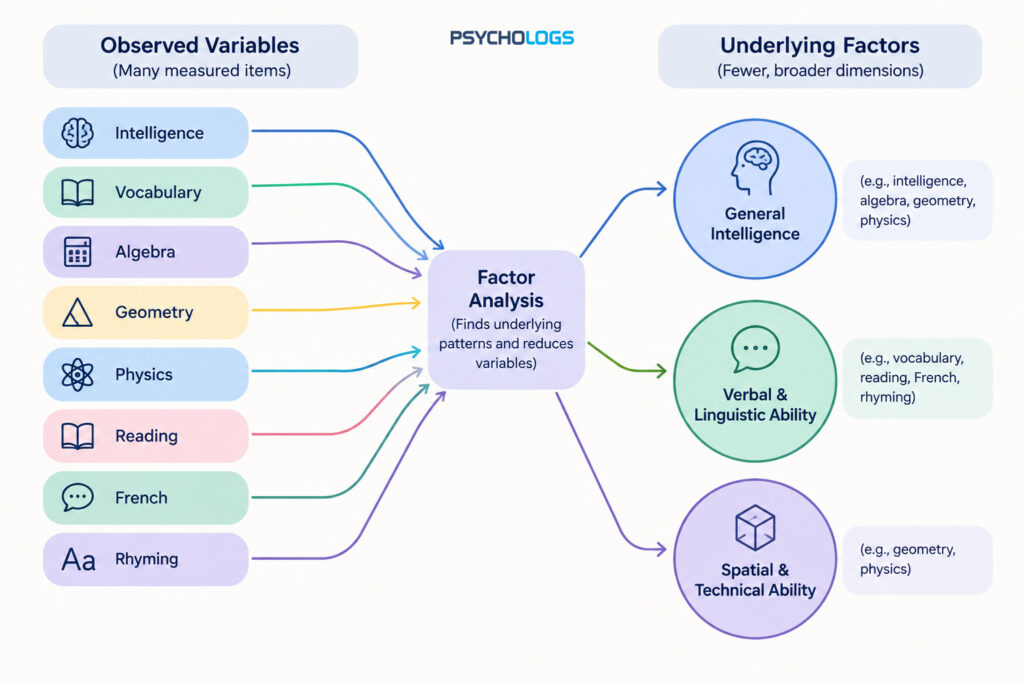
Illustration of Factor Analysis
In order to understand the above definitions and concepts, below is a detailed illustration of Factor Analysis and Factor Loading.
| Variables | Factor 1 | Factor 2 | Factor 3 |
| Intelligence | 0.82 | 0.63 | 0.44 |
| Non- Verbal IQ | 0.78 | 0.35 | 0.51 |
| Vocabulary | 0.68 | 0.64 | 0.21 |
| Rhyming | 0.28 | 0.59 | 0.18 |
| Algebra | 0.45 | 0.20 | 0.38 |
| Geometry | 0.50 | 0.17 | 0.69 |
| Physics | 0.41 | 0.13 | 0.37 |
| Latin | 0.58 | 0.70 | 0.20 |
| French | 0.32 | 0.68 | 0.17 |
| History | 0.25 | 0.43 | 0.12 |
| Engineering | 0.49 | 0.09 | 0.60 |
The above tables comprise a total of 11 different subjects and abilities, which are in the first column, ‘Variables’, and the next three columns ‘, Factor 1 ‘, ‘ Factor 2 ‘, and ‘ Factor 3 ’, are the factor loadings. Factor Analysis looks at the hidden patterns behind these variables. The numbers are what we call as factor loadings.
- Factor 1: This column represents General Intelligence. The key loadings here include: Intelligence(0.82), Non-Verbal IQ(0.78), Vocabulary(0.68). General IQ has the highest loading, indicating general problem-solving ability.
- Factor 2:This column represents Verbal & Linguistic Ability; the key loadings here include: Latin(0.70), French(0.68), Vocabulary(0.64) and Rhyming(0.59). The subjects requiring this ability are grouped.
- Factor 3: This Column represents Spatial & Technical Ability; the key loadings here include: Geometry (0.69), Engineering(0.60), Nonverbal IQ (0.51). Similarly visual spatial technical subjects are clustered here.
In gist, instead of assessing human ability in 11 separate subjects, Factor Analysis helped in viewing these abilities under three underlying dimensions. The subject relies on that specific core ability, indicating a higher test score factor loading. The above example illustrates how Factor analysis simplifies and reduces complex sets of data or variables(Kline, 2014).
Read More: Two Systems, One Mind: Understanding Human Cognition Through Dual Process Theory
Factor Analysis and Personality Theory
Factor Analysis has been of beneficial use in behavioural sciences. Especially in determining personality traits. All the personality traits derived have one common method in use, which is Factor Analysis. Factor Analysis helped personality psychologists to narrow the wide array of personality traits into specific traits.
- Raymond Cattell’s 16 Personality Factors: To understand the use of Factor Analysis, it is important to understand Raymond Cattell’s work. Raymond Cattell used factor analysis to identify the traits that underlie our personality. It is known that Gordon Allport came up with 4000 traits of personality; Cattell reduced the list to 171 characteristics, and he further condensed them to 16 Personality Factors. His 16 Personality Factors are used in career development, Human Resources, Personality Assessment, and Research (Cherry, 2026).
- Eysenck’s Personality Theory: Hans Eysenck made use of Factor Analysis and proposed a Theory on Biological Factors; he came up with the PEN Model: extraversion, neuroticism, and psychoticism to explain personality(McLeod,2024).
Characteristics of Factor Analysis
- Factor Analysis enables easy analysis of 100s of variables with the help of computer software.
- It identifies the functional units or sets from the complex datasets; that is, it disentangles complex interrelations.
- Factor Analysis is a flexible instrument that enables us to understand the hidden patterns of a wide range of research designs such as: Hypothesis Testing, Concept Mapping, Case Studies, time series, voting results, sample surveys, etc.
- Though Factor Analysis has its roots in Psychology, it is also widely used in other disciplines such as Maths, statistics, etc.
- Importantly, it yields results which can help to predict and understand behaviour(Rummel,1970).
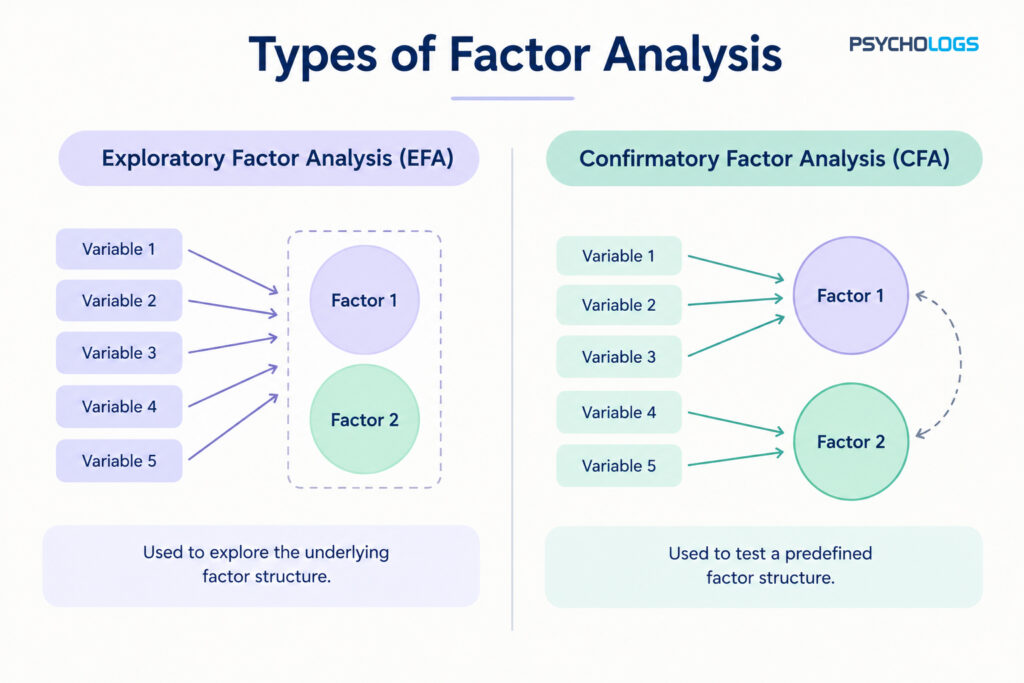
Types of Factor Analysis
There are two main types of Factor Analysis, namely Exploratory Factor Analysis (EFA) and Confirmatory Factor Analysis (CFA). They differ in two main aspects: the first being whether the researcher is testing the pre-existing theory/hypothesis or, second, searching for patterns.
1. Exploratory Factor Analysis
Exploratory Factor Analysis is widely used when the researcher has to establish an instrument. One of the common objectives of EFA is to determine what features are most important when classifying a group of items. Researchers, along with experts, prepare reviews of the literature and select as many variables as possible to fully represent the construct. Statistical software such as SAS, R, and SPSS provides factor loadings. EFA enables us to determine the common factors influencing the set of variables. If a researcher subscribes to EFA, it is important to take a wide variety of measures in order to get factor loadings which can be generalised. There are seven steps in performing EFA :
- Collect measurements
- Obtain correlational matrix
- Select the number of factors for inclusion
- Extract your initial set of factors
- Rotate your factors to a final solution
- Interpret your factor structure
- Construct factor scores for further analysis
2. Confirmatory Factor Analysis (CFA)
Confirmatory factor analysis (CFA) can be performed or used when confirming the underlying hidden patterns (factors. It extends the findings of Exploratory Factor Analysis(EFA). CFA is a theory-driven model that tells how efficiently the data fit the theory. Essentially, CFA is meant to test the internal structure of the instruments. The main objective of the CFA is to determine the ability of the predefined factor model to fit the observed data. Some of the common uses of CFA include: it helps to establish the validity of single data; it tests the significance of specific factor loadings. There are six basic steps while performing CFA :
- Define the Factor Model
- Collect Measurements
- Obtain the correlation matrix
- Fit the model to the data
- Evaluate model adequacy
- Compare with other models(Decoster,1998;Tavakol et al., 2020).
Read More: HEXACO Model of Personality
Conclusion
In conclusion, Factor Analysis is a statistical tool that enables interpreting large datasets in an easy way. It helps to establish and explore the interrelationships between variables by converting them into factors. The field of behavioural sciences has its roots in Charles Spearman advocated his two-factor theory in 1904. There are two types of factor analysis: Exploratory and Confirmatory Factor Analysis. Factor Analysis becomes an important tool in psychology as understanding human behaviour is complex, and there lie many hidden patterns of human behaviour. Thus, Factor Analysis helps in analysing those hidden parts and disentangling the nuances of human behaviour.
References +
- Tavakol, M., & Wetzel, A. (2020). Factor Analysis: a means for theory and instrument development in support of construct validity. International journal of medical education, 11, 245–247. https://doi.org/10.5116/ijme.5f96.0f4a (Intro + Types)
- Rajiv Chooramun. Tracing the historical, theoretical, and mathematical foundations of factor analysis and principal component analysis. Int J Stat Appl Math 2025;10(4):05-12. DOI: 10.22271/maths.2025.v10.i4a.2014
- Kim, J.-O., & Mueller, C. W. (1978). Introduction to factor analysis: What it is and how to do it. SAGE Publications. https://doi.org/10.4135/9781412984652
- Kline, P. (2014). An easy guide to factor analysis. Routledge DeCoster, J. (1998). Overview of factor analysis. University of Alabama. http://www.stat-help.com/notes.html
- Rummel, R. J. (1970). Applied factor analysis. Northwestern University Press. Yong, A. G., & Pearce, S. (2013). A beginner’s guide to factor analysis: Focusing on exploratory factor analysis. Tutorials in quantitative methods for psychology, 9(2), 79-94. https://doi.org/10.20982/tqmp.09.2.p079
- Cherry, K. (2023, April 7). Cattell’s 16 personality factors. Verywell Mind. https://www.verywellmind.com/cattells-16-personality-factors-2795977
- McLeod, S. (2024). Theories of Personality: Hans Eysenck, Gordon Allport & Raymond Cattell. Simply Psychology. https://www.simplypsychology.org/personality-theories.html