
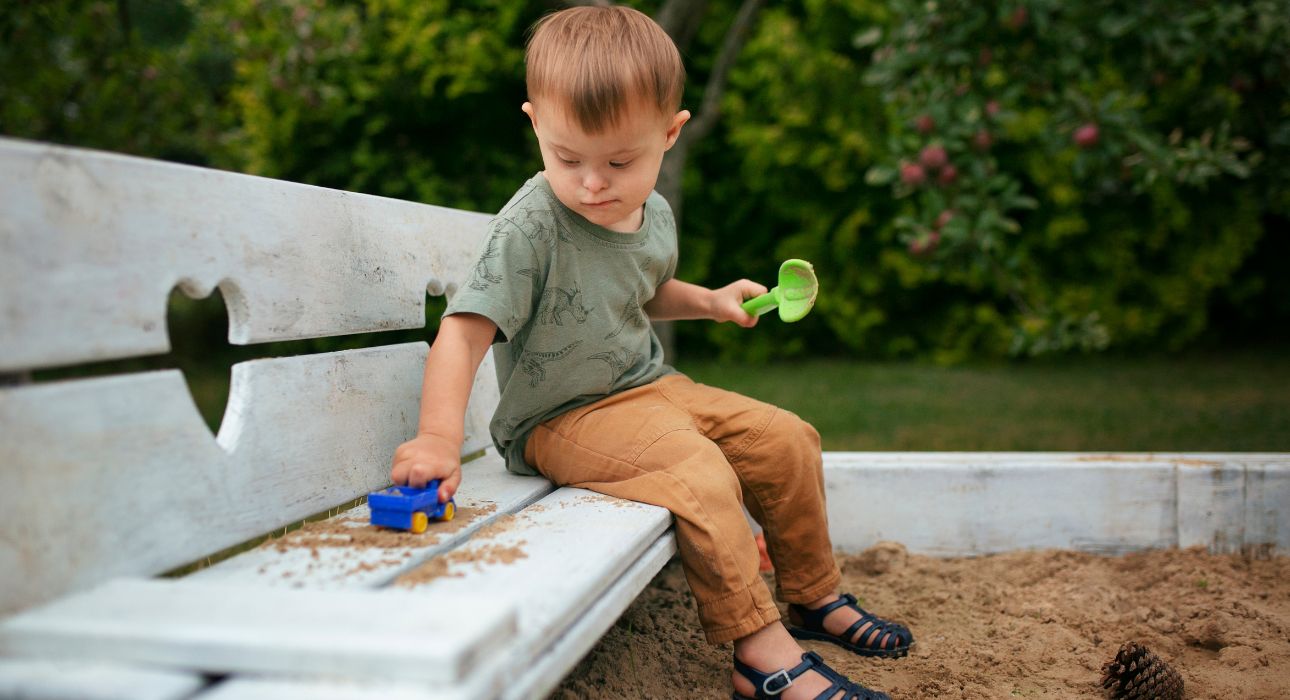
Infants understand the world through two processes. One of them is sensation, and the other is perception. Sensation involves the sense organs, like the eyes, nose, ears, and the physical data from them. Perception is the brain interpreting and analysing the information received. As infants grow, their perception grows with them. This is perceptual development. Visual perception is an important part of an infant’s understanding of their environment. An infant’s vision grows slowly. Most infants before the age of 6 months can only see as clearly as an adult with glasses can see without them. It takes them around 6 to 8 months to reach a near-adult level of vision (Feldman, 2017).
Other visual abilities, like binocular vision, are important in visual perception. Binocular vision is the ability to combine the vision from both eyes to get an accurate judgement of depth and motion (Feldman, 2017). Depth perception, pattern recognition and face perception are important parts of visual perception in infants and perceptual growth. This article explores the same along with a quick look at Gibson’s Ecological theory of perception.
Read More: Perceptual Processing
Depth Perception
Depth perception is the ability to see in 3D and to judge how far things are (Depth Perception, 2018). Researchers Gibson and Walk (1960) studied depth perception in various animals and human infants. The question was: how do infants learn to recognise that they could fall off places? Is it by experience or innate? Their take on space perception took the form of height and depth perception. Early versions of this experiment involved various animals such as turtles, goats, rats, and chicks (Gibson & Walk, 1960). This was done with a simple setup called the visual cliff.
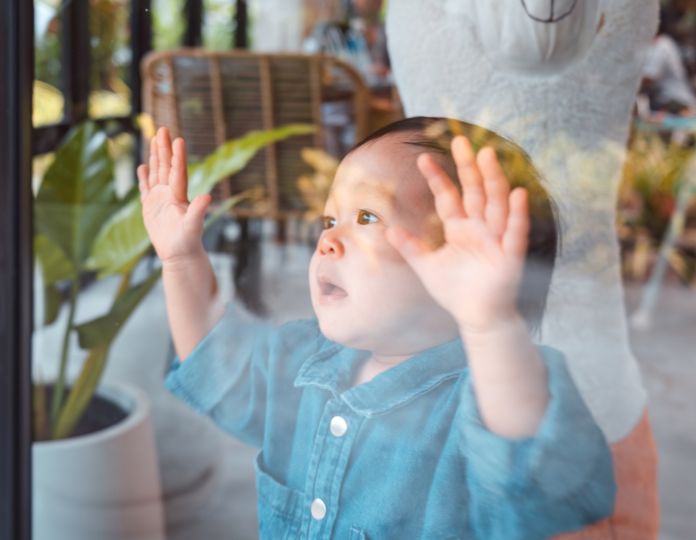
A visual cliff is the illusion of a steep drop from a surface. The infants were placed on a glass with an illusory cliff on one side and plain ground on the other. The cliff was made by setting up the glass an inch above the ground. This made two sides for the participants to cross from: the cliff side and the shallow side (Gibson & Walk, 1960; Feldman, 2017).
Thirty-six infants between the ages of 6 and 14 months were tested. Each infant was placed on the board, and their mother called them from either the shallow side or the cliff side. Only three of the infants crawled to the cliff side, while a majority crossed to the shallow side.
Many of the infants even crawled away from the mother when she called out from the cliff side. Some of these infants would even peer at the edge of the cliff side, back away and cry. Some others would pat the glass but refuse to cross despite the physical contact and reassurance about the existence of the glass (Gibson & Walk, 1960; Feldman, 2017). This acted as evidence of the infants’ dependence on vision and showcased the fact that depth perception had developed at that age. The experiment did not prove that the infants’ perception of depth was innate.
The experiment did not consider that depth avoidance does not necessarily mean perception. The infants already had crawling experience, and avoiding the cliff might just have been learned behaviour. (Gibson & Walk, 1960; Feldman, 2017). In other experiments, infants of only two or three months were placed on their stomachs on such a visual cliff and on an apparent ground; they showed a difference in their heart rates. Whether this is a result of the perception of depth or just a perception of change in stimuli is uncertain (Campos et al., 1970; Spillman & Werner, 1990).
Read More: The Role of Metacognition in the Brain
Gibson’s Theory of Direct Perception
Gibson’s theory talks about how the environment is directly perceived as opportunities rather than the brain putting together sensory information. This theory places importance on the environment and context. It argues that the environment is directly perceived for its action potential. These opportunities are called affordances. They offer a chance for action, be it good or bad. For instance, a flat surface allows for an opportunity to walk. Different substances in the environment allow for different affordances (Khatibi & Sheikholeslami, 2015). An affordance can be subjective or objective, physical or psychological and environmental or behavioural. Gibson’s theory further talks about types of affordances in the terrestrial environment. One is a medium, e.g., air for humans, which lets one breathe.

Then come substances, eg, water, which can be drunk or poured. Surfaces also afford something, eg, flat, rigid surfaces can be walked on; water can be swum in; vertical surfaces can be climbed. Objects also afford something, eg, a long object like thread affords stitching. Other humans and animals, and places also are affordances (Khatibi & Sheikholeslami, 2015).
The theory does a good job of describing why perception happens quickly and why different people have the same perception of certain things. However, it fails to take into account memory and does not explain why incorrect perceptual interpretations might happen (Martin, 2026; Khatibi & Sheikholeslami, 2015)
.
Read More: Thresholds in Psychophysics: Exploring Sensory Perception and Its Diverse Applications
Gibson’s Theory of Perceptual Learning
Perceptual learning is an enhancement of the ability to interpret sensory information. It is highly experience-dependent and adapts according to experience. Gibson’s theory of perceptual learning talks about how this process involves differentiation, selection, and extraction of information. They theorise that perception improves through discovering new information about the world. This involves exploratory activities to learn more. When uncertainty is reduced, the search for information might be terminated, but animals are always looking for specific information for affordances. (Gold & Watanabe,2010; Adolph & Kretch, 2015)
1. Pattern perception
Pattern recognition is the process of observing and identifying similar features in the environment (Jones & Rivett, 2004). Fantz and colleagues in 1961 conducted a number of experiments called the looking chamber experiments. The focus was on the degree to which infants could perceive and categorise their environment. In their first experiment, infants from the age of 15 weeks to one year were placed in a ‘looking chamber’.
From this chamber, they could see two different patterns at the same time. The eye activity of the infants was followed to see if the infants preferred one pattern over the other. They found that the time spent looking at different patterns varied, and the infants showed a preference for more complex patterns. Even infants a few minutes old showed this preference for patterns. This provided support for the idea that these preferences might be genetic. This experiment provided support for the idea that infants’ pattern perception developed incredibly early.
Fantz’s experiments did not take into consideration things like confusion about a pattern, staring without understanding and that infants get sleepy and hungry easily and have short attention spans. (Fantz, 1961; Fantz, 1963; Feldman, 2017). Further research was conducted. One of these was on shapes that looked like faces. Infants were seen to prefer face-like shapes that had organised features. This was in comparison to face shapes that had scrambled features (Fantz, 1961; Fantz, 1963; Feldman, 2017).
2. Face perception
Face perception is a process of recognising faces. Bushnell conducted multiple experiments on this. It was found that infants show face recognition within a short time after birth. His studies also found that infants show a preference for their mother’s face. Bushnell followed twenty-nine full-term babies for three days and noted the time they spent looking at their mothers. Bushnell found that the more time infants spent looking at their mother, the more fixated they were on her face later, when they saw both her and a stranger. Further studies have also shown that infants can discriminate between male and female faces (Haxby et al., 2002; Bushnell, 2001; Feldman, 2017)
3. Object perception
The perception of an object in infancy consists of two important concepts, shape and size constancy. Size constancy is the ability to perceive an item as the same size even if the retinal image of it is different. Shape constancy is the ability to perceive the object as the same shape despite changes in the retinal image due to angles and other causes. Studies show that shape and size constancy are highly developed even at birth (Slater, 1992; Sperandio & Chouinard, 2015; Pizlo, 1994).
Read More: Cognitive Development Theory: Piaget
Conclusion
In conclusion, perceptual development is an interaction between innate qualities and experience, where nature and nurture work together. Perception is an active process. Whether depth perception, face perception, object perception or pattern perception, infants have a better sense of their environment than was once believed. Gibson’s experiment looked into depth perception amongst babies who can crawl. This proved that infants do have depth perception. Fantz’s experiment on pattern recognition proved that newborns can see patterns and prefer the more complex ones.
Bushnell’s experiment on faces proved that newborns do have face recognition, and researchers observed that they preferred their mothers’ faces when exposed to them for long enough. Size and shape constancy are about the actual shape and size of objects remaining the same despite them looking different. Gibson’s theory of perceptual learning talks about how learning improves through new information. Gibson’s theory of direct perception theorises that we perceive the environment directly for its action potential and affordances.
References +
- Gibson, E. J., & Walk, R. D. (1960). The “visual cliff.” Scientific American, 202, 67–71.
- Feldman, R. S. (2017). Development Across the Life Span (8th ed.). Pearson.
- Campos, J. J., Langer, A., & Krowitz, A. (1970). Cardiac responses on the visual cliff in prelocomotor human infants. Science, 170, 196
- Spillman, L., & Werner, J. S. (Eds.). (1990). Visual perception: The neurophysiological foundations. San Diego, CA: Academic Press.
- Depth perception. (2018, March 23). American Academy of Ophthalmology. https://www.aao.org/eyehealth/anatomy/depth-perception
- HappyNeuron. (2026, May 5). Exploring Cognitive Skills: Pattern Recognition –
- HappyNeuron Pro. HappyNeuron Pro. https://www.happyneuronpro.com/en/info/what-is-patternrecognition/
- Fantz, R. L. (1961). The origin of form perception. San Francisco: W.H. Freeman. Fantz, R. L. (1963). Pattern Vision in Newborn Infants. Science, 140(3564), 296-297. doi:10.1126/science.140.3564.296
- Haxby, J. V., Hoffman, E.A., Gobbini, I. (2002). Human neural systems for face recognition and social communication, Biological Psychiatry, Volume 51, Issue 1, Pages 59-67, ISSN 0006-3223, https://doi.org/10.1016/S0006-3223(01)01330-0.
- Bushnell, I. (2001). Mother’s Face Recognition in Newborn Infants: Learning and Memory. Inf. Child Dev., 10. 10.1002/icd.248.
- Slater, A. (1992). The Visual Constancies in Early Infancy. The Irish Journal of Psychology, 13(4), 412–425. https://doi.org/10.1080/03033910.1992.10557902
- Sperandio, I., & Chouinard, P. A. (2015). The Mechanisms of Size Constancy. Multisensory Research, 28(3-4), 253–283. https://doi.org/10.1163/22134808-00002483
- Pizolo Z. (1994). A theory of shape constancy based on perspective invariants. Vision Research, 34(12), 1637-1658. https://doi.org/10.1016/0042-6989(94)90123-6
- Martin, A. (2026, November 7). Direct Theory Of Perception (Gibson, 1966) | Bottom-up Theory & Strengths.
- Online Learning College. https://online learningcollege.com/knowledge-hub/gcses/gcse-psychology help/direct-theory-of-perception-gibson-1966/
- Jones, M. A.,& Rivett, D. A., (2004), CHAPTER 1 – Introduction to clinical reasoning, Clinical Reasoning for Manual Therapists, Butterworth-Heinemann, Pages 3-24, ISBN 9780750639064, https://doi.org/10.1016/B978-0-7506-3906-4.50006-X.
- Khatibi, M., & Sheikholeslami, R. (2015). Gibson’s Ecological Theory of Development and Affordances: A Brief Review. International Journal of Indian Psychology, 2(4). https:// doi.org/10.25215/0204.054
- Gold, J. I., & Watanabe, T. (2010). Perceptual learning. Current Biology, 20(2), R46– R48. https://doi.org/10.1016/j.cub.2009.10.066
- Adolph, K., & Kretch, K.(2015). Gibson’s Theory of Perceptual Learning. International Encyclopedia of the Social & Behavioural Sciences (Second Edition). ISBN 9780080970875. https://doi.org/10.1016/B978-0-08-097086