


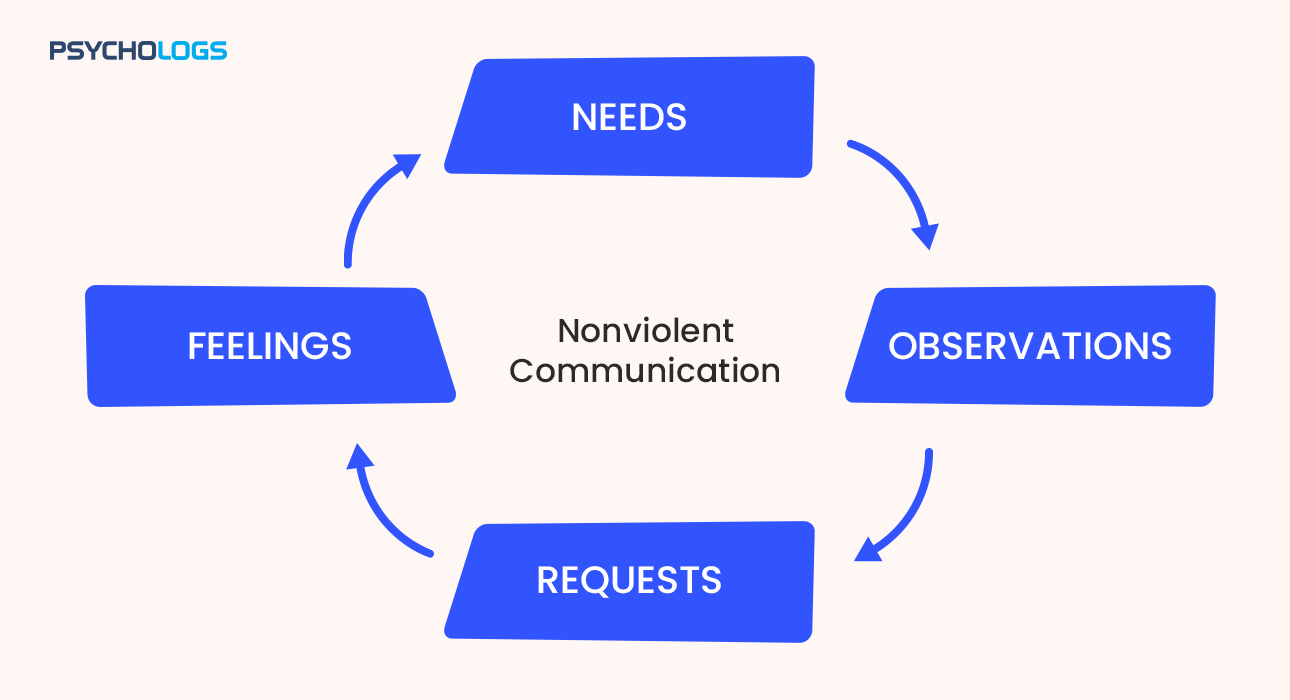
All of us learned to communicate in a dialogue without being taught how we should act in case of a dialogue failure. The technique, invented in the 1960s and 1970s by psychologist Marshall Rosenberg, is called Nonviolent Communication (NVC). As Rosenberg (2015) claims, the method focuses on relating to ourselves and to others in the ways that make compassion possible. He was inspired by humanistic psychology, which he studied under his mentor, Carl Rogers, and by his mediation experience of racial conflict resolution in American schools.
The technique is based on the principle that most of the conflicts are not generated by the needs themselves but by the ways they are stated and perceived. Judgments, blame, and demands create defensiveness, while open and sincere expression of our feelings and attention to the feelings of other people decrease defensiveness. This article introduces you to the Nonviolent Communication approach and its limitations.
The Four Components
The NVC model is usually presented to students with four steps. They are observation, feelings, needs, and request according to Rosenberg (2015).
1. Observation
The first step involves the description of the situation without any evaluation. An observation is something one can see on a video: “You arrived at 7:40, although we agreed to meet at 7:00.” Evaluations involve interpretation: “You are always late and rude.” It is necessary to realise the difference between these two concepts as people give their responses to the attack. It is not a problem people face but the criticism that makes people respond to this attack.
This point is supported by the research done by Gottman among couples. The researcher found that conversations that started with criticism or contempt, “harsh startup,” were significantly correlated with disintegration of the relationship (Gottman & Levenson, 1992). Later, Gottman showed that the tone of the first three minutes of conflict discussion predicted divorce among new couples with 96% accuracy (Carrère & Gottman, 1999).
2. Feelings
Second, describe your emotions: “I felt worried and somewhat ashamed.” While explaining nonviolent communication principles, Rosenberg made the distinction between authentic emotions, like worrying, relief, sadness, and pseudoemotions that already presuppose some judgment in their nature. “I feel ignored” is not a feeling but rather your evaluation of the behaviour of others, which can be accompanied by the feelings of loneliness and hurt.


There is scientific proof of the importance of such differentiation found in the works of Lieberman et al. (2007), who conducted neuroimaging research and showed that affect labelling decreases the activation of the amygdala and enhances the activity of the right ventrolateral prefrontal cortex, which is related to the emotional regulation process.
Thus, describing your feelings makes them easier to manage. Emotional granularity shows the same trend. Discrimination between similar negative emotions, like frustration, disappointment, and anxiety, enhances emotional flexibility in the emotional regulation process (Barrett et al., 2001; Kashdan et al., 2015).
3. Needs
In the third step, you connect the emotion with the need, which is an inherent need of humans to feel safe, autonomous, respected, connected, rested, and meaningful. The essence of Rosenberg’s position is that emotions occur due to our needs, not actions of other people. You were not scared because of your lateness; you were scared because the need for reliability and consideration remained unfulfilled. However, actions might evoke certain feelings, but needs determine what kind of feelings those are. It is similar to the traditional role of needs in the theory of motivation in psychology.
For instance, Maslow (1943) offered a hierarchy of needs. The self-determination theory claims that there are three basic psychological needs autonomy, competence, and relatedness- failing to meet which predicts suffering and meeting successfully which predicts well-being (Deci & Ryan, 2000). Baumeister & Leary (1995) stated that the sense of belongingness is a basic human motivation. Nonviolent communication gives the vocabulary for discussing the needs of people. Strategies are not the same as needs. “I need you to call me every day” is a strategy, and “I need connection” is a need. There can be various ways of satisfying one and the same need.
4. Requests

The last one is the request: “Can you text me if you think you’ll be more than ten minutes late?” Rosenberg (2015) differentiated between the requests and demands. The request presupposes a refusal.
The demand includes an implicit threat of blaming or punishing for refusal. Should the listener be coerced, he will feel resentful about obeying, and the connection pays for it. Effective requests are always clear and not abstract (“text me by 6 p.m.”, but not “be considerate”); they are expressed in the present tense and formulated positively.
How to Unite All Four Components in One Expression
There is a pattern for the whole expression: “When I see/hear [observation], I feel [feeling] because I need [need]. Would you be willing to [request]?” An example of NVC application can be seen in this case:
- Unstructured: “You never help around here. You’re so lazy.”
- NVC: “When I see the dishes in the sink after I’ve cooked dinner three nights in a row, I feel tired and a little resentful, because I need a feeling of teamwork at home. Would you be willing to take the dishes tonight and discuss the distribution of duties this weekend?”
The second version won’t always work. But it makes cooperation easier than the first does, because it gives the listener something to respond to other than an attack.
Empathy, Listening and Emotional Intelligence
Non-violent communication comprises two aspects, including self-expression, which means being honest and empathic listening. Empathic listening means understanding the message from the sender of the information regardless of the nature of criticism in the message. For example, when one’s workmate shouts, “Your report is a disaster,” an empathic reaction to this message should be as follows: “Are you frustrated due to the need of using these figures in your presentation?”
The stated approach reminds of the client-centred approach developed by Rogers. In particular, Rogers (1957) claims that such aspects as empathy, unconditional positive regard and congruence were the key factors of change, while active listening in Rogers & Farson (1957) included repetition and restatement of what the speaker feels and thinks. Empathy involves some aspects. According to Decety & Jackson (2004), affective sharing, perspective taking, and emotional regulation occur in NVC. In turn, Batson (1991) showed that empathy can motivate people to help others.
Emotional awareness is the basis for everything mentioned above. When you do not have an emotional awareness and cannot identify your emotions and needs, then you will not be able to express them. NVC provides for practising self-empathy by pausing for a moment and looking at your feelings and needs prior to doing something about them. This is very much like what Gross (1998) called antecedent emotion regulation, which means intervening in your emotions prior to their complete manifestation.
Conflict Resolution and Relationship Dynamics
The NVC approach helps people move from positions (“You should apologise”) to needs (“I want to feel respected”). In this way, the NVC approach will resemble principled negotiation since it is necessary to focus on interests and not on positions (Fisher & Ury, 1981). As both parties have a chance to reveal their needs without blaming someone, various solutions that can satisfy all participants will emerge.

From the perspective of interpersonal relations, the NVC approach pays attention to certain patterns identified by Gottman and Silver (1999) as “toxic” patterns: criticism, contempt, defensiveness, and stonewalling (“Four Horsemen”). The NVC approach proposes alternative solutions to these patterns:
- Criticism: Observation and need. One reveals the observed behaviour and its effects on others, not insulting the personality traits of other people.
- Contempt: Empathy. One tries to analyse the need that makes other people act in a particular manner.
- Defensiveness: Listening to the need behind the message. When you understand criticism as a need, you eliminate defensiveness.
- Stonewalling: Self-empathy and time-out. One recognises physiological flooding and takes a time-out.
Such practices will create deposits in Gottman’s “emotional bank account”.
Applications
Some examples of how NVC has been applied include:
- Parenting and family relationships: to help children understand their feelings and needs and help the parents voice out their needs without being forced to do so.
- Education: conflict resolution and reconciliation practices that have been seen in the previous study by Rosenberg.
- Medicine: learn the art of empathic communication from the medical practitioners. NVC training in medicine, as stated by Museux et al. (2016), improved teamwork and communication.
- Business: for giving feedback and handling difficult situations.
- Community and building peace: mediation in tough situations was practised by Rosenberg himself.
What the Research Says, and Doesn’t
The strongest evidence in favour of the NVC technique is an indirect one. The components of the NVC fit into empirically verified information about affect labelling, needs satisfaction, empathy, as well as aggressive and cooperative conflict behaviours. However, there is no sufficient evidence concerning the fact that there might be better results when using the NVC technique. Researchers normally study NVC with a small number of people who are not randomised, and they do not use an active control group. They also usually rely on self-report techniques (see, for example, Museux et al., 2016).
Conclusion
One of the most complicated jobs Nonviolent Communication does is providing a practical model of how to be honest and authentic during communication that is likely to make the other person feel threatened. The components of Nonviolent Communication enable the person to describe a situation objectively, to point out his or her feelings, to connect them to needs and to ask for something in a way that respects the independence of the other person. Having a basis in such notions as empathy and self-awareness, Nonviolent Communication fits a great deal of scientific work perfectly in the area of emotion regulation, motivation and relationship studies. However, researchers have not yet found much evidence of its efficiency.
References +
- Barrett, L. F., Gross, J., Christensen, T. C., & Benvenuto, M. (2001). Knowing what you’re feeling and knowing what to do about it: Mapping the relation between emotion differentiation and emotion regulation. Cognition & Emotion, 15(6), 713–724.
- Batson, C. D. (1991). The altruism question: Toward a social-psychological answer. Lawrence Erlbaum.
- Baumeister, R. F., & Leary, M. R. (1995). The need to belong: Desire for interpersonal attachments as a fundamental human motivation. Psychological Bulletin, 117(3), 497–529.
- Brown, P., & Levinson, S. C. (1987). Politeness: Some universals in language usage. Cambridge University Press.
- Carrère, S., & Gottman, J. M. (1999). Predicting divorce among newlyweds from the first three minutes of a marital conflict discussion. Family Process, 38(3), 293–301.
- Decety, J., & Jackson, P. L. (2004). The functional architecture of human empathy. Behavioural and Cognitive Neuroscience Reviews, 3(2), 71–100.
- Deci, E. L., & Ryan, R. M. (2000). The “what” and “why” of goal pursuits: Human needs and the self-determination of behaviour. Psychological Inquiry, 11(4), 227–268.
- Fisher, R., & Ury, W. (1981). Getting to yes: Negotiating agreement without giving in. Houghton Mifflin.
- Gottman, J. M., & Levenson, R. W. (1992). Marital processes predictive of later dissolution. Journal of Personality and Social Psychology, 63(2), 221–233.
- Gottman, J. M., & Silver, N. (1999). The seven principles for making marriage work. Crown.
- Gross, J. J. (1998). The emerging field of emotion regulation: An integrative review. Review of General Psychology, 2(3), 271–299.
- Hall, E. T. (1976). Beyond culture. Anchor Books.
- Kashdan, T. B., Barrett, L. F., & McKnight, P. E. (2015). Unpacking emotion differentiation: Transforming unpleasant experience by perceiving distinctions in negativity. Current Directions in Psychological Science, 24(1), 10–16.
- Lieberman, M. D., Eisenberger, N. I., Crockett, M. J., Tom, S. M., Pfeifer, J. H., & Way, B. M. (2007). Putting feelings into words: Affect labelling disrupts amygdala activity in response to affective stimuli. Psychological Science, 18(5), 421–428.
- Maslow, A. H. (1943). A theory of human motivation. Psychological Review, 50(4), 370–396.
- Museux, A.-C., Dumont, S., Careau, E., & Milot, É. (2016). Improving interprofessional collaboration: The effect of training in nonviolent communication. Social Work in Health Care, 55(2), 136–153.
- Rogers, C. R. (1957). The necessary and sufficient conditions of therapeutic personality change. Journal of Consulting Psychology, 21(2), 95–103.
- Rogers, C. R., & Farson, R. E. (1957). Active listening. Industrial Relations Centre, University of Chicago.
- Rosenberg, M. B. (2015). Nonviolent communication: A language of life (3rd ed.). PuddleDancer Press.