


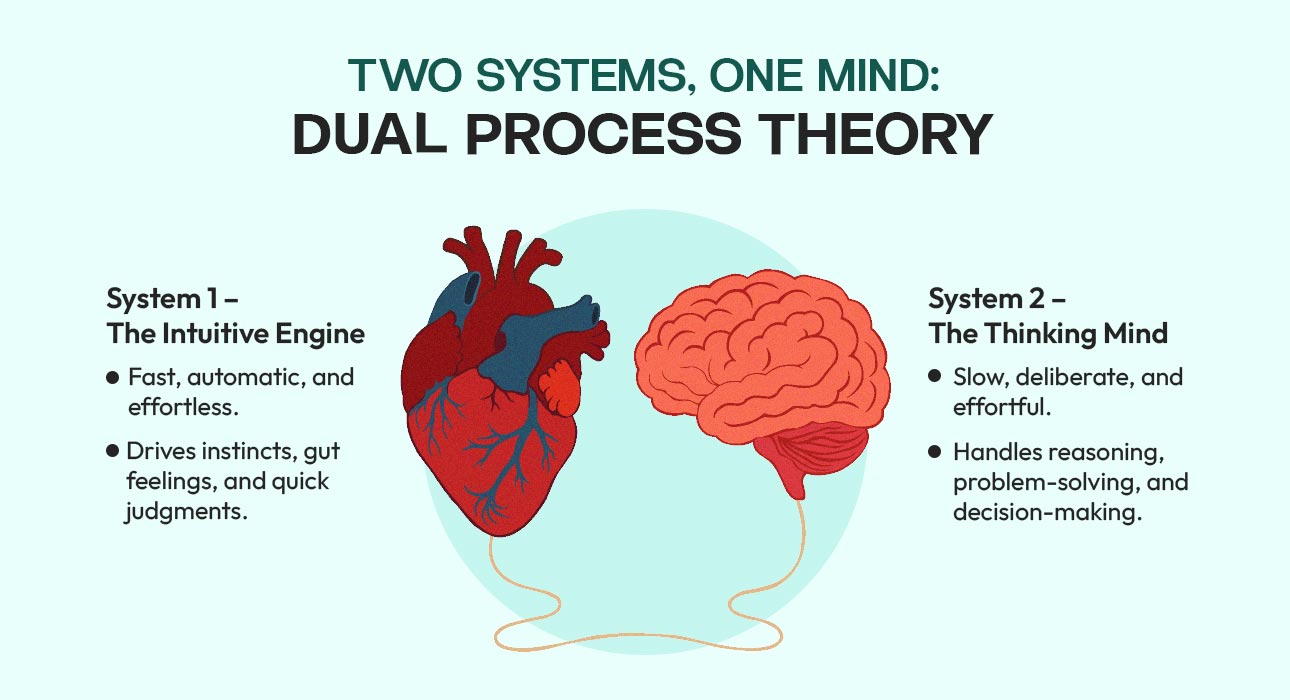
The human mind looks a lot like a single powerful processor, but modern cognitive science tells us a very different story of a “divided” architecture. Under the Dual Process Theory, which now informs our view, our thinking, judgment, and behaviour flow from two completely distinct modes of thought. Known as System 1 and System 2, their functional structure reflects the human brain’s inheritance and was designed to provide more visceral, immediate functions for biology and to respond to the slower, more rational processes of civilisation and logic (Kahneman, 2011). An examination of the architecture of the mind (Stanovich & West, 2000) reminds us that human rationality is not something that we are born with, but rather, a contingent compromise between the “fast” urges of our ancestors and the “slow” deliberation of the modern mind.
The Foundations of Dual Process Theory

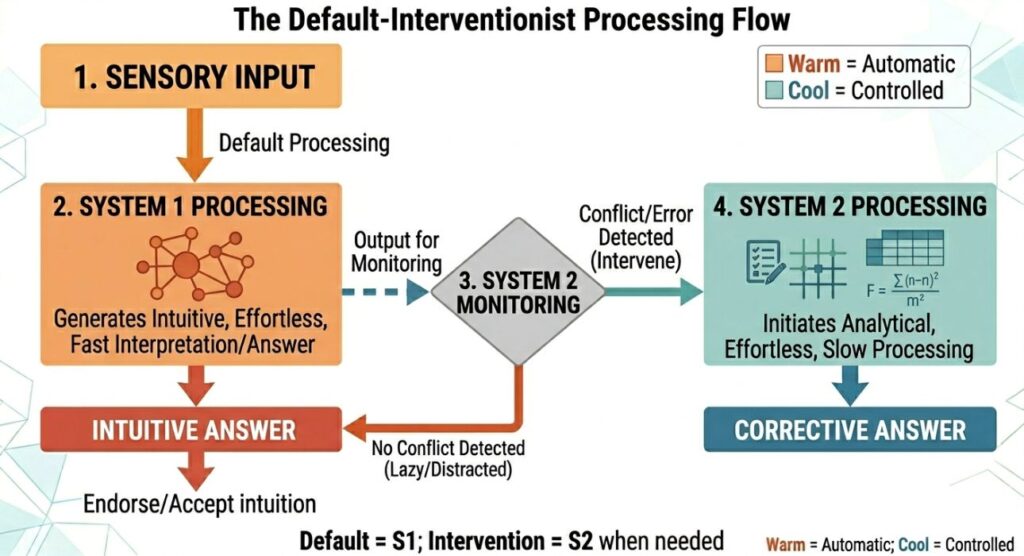
Image Source: Image generated using Gemini by Google, 2026
Dual process models posit that human cognition is controlled by two systems of thought. Although different theorists have been discussing the different nomenclatures for dual process theories, the most common terminology (first introduced by Keith Stanovich and Richard West, 2000, and Daniel Kahneman, 2011) has labelled these in broad strokes as only System 1 and System 2.
System 1: The Intuitive Engine
System 1 works automatically and rapidly, without much input from the person or any knowledge of the control systems. It is the domain of “gut feelings,” instincts, and heuristics. From an evolutionary point of view, the first system is older, common to all other creatures and specialised for immediate survival. It deals with everyday things like recognising hostility in a voice or saying the sentence “bread and…” (Kahneman, 2011).
System 2: The Architect of Contemplation
System 2 focuses on those mental activities that require it, such as computation. This concept is related to the subjective experience of agency, choice, and concentration. System 2 is slower, methodical, and rule-regulated. It is what we most often think in terms of “thinking” solving a difficult math problem or completing a complicated tax form (Evans & Stanovich, 2013).
The Theory Through The Ages
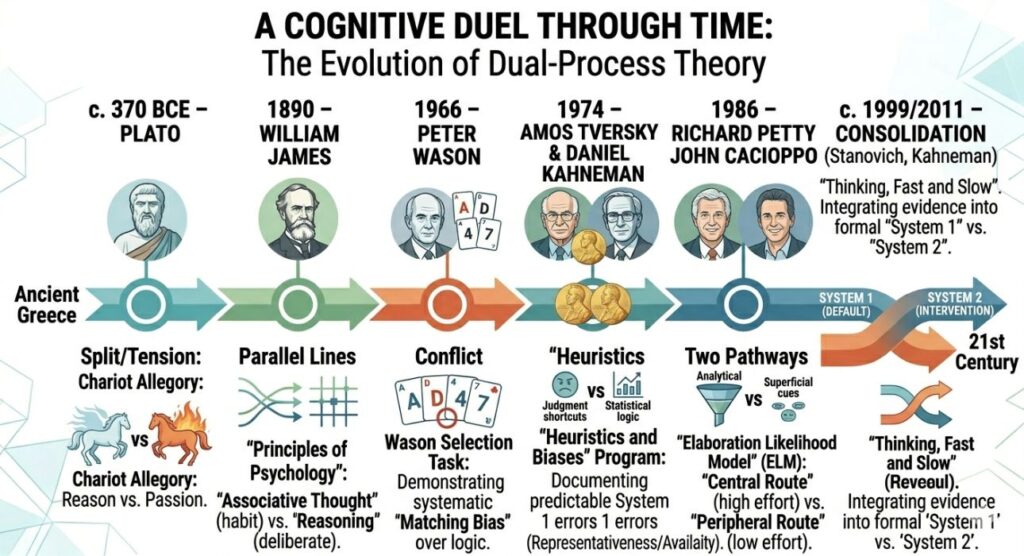
Image Source: Image Generated Using Gemini by Google,2026
Two methods of dual-processing can be discovered in ancient philosophy, such as Plato’s chariot allegory, in which one horse symbolises passion (System 1) and the other reason (System 2). But those modern psychological twists picked up steam in the 1970s and ’80s.
- Wason Selection Task (1966)—Very early experiments in thinking in logic showed quite simply that humans often do not succeed at simple logical puzzles because they are using “matching bias,” or (a System 1 shortcut), because heuristic and not deductive reasoning (a System 2) is the reason why they fall.
- Heuristics and Biases Program: A study conducted by Amos Tversky and Daniel Kahneman (1974) showed that individuals will make judgments in the face of such uncertainty because of mental shortcuts, the use of which is called heuristics (a shortcut). This study established the empirical basis for explaining “Errors” of System 1.
- Elaboration Likelihood Model (ELM): For instance, Petty and Cacioppo (1986) in social psychology suggest two routes of persuasion: the central route (deep processing) and the peripheral route (superficial cues), which reflect the dual-process model.
Common Features and Contrasts
Such studies are often distinguished based on their functional characteristics.
| Feature | System 1 (Intuitive) | System 2 (Reflective) |
| Speed | Fast | Slow |
| Effort | Low (Automatic) | High (Controlled) |
| Capacity | High (Multitask) | Low (Limited/Serial) |
| Consciousness | Unconscious / Implicit | Conscious / Explicit |
| Evolution | Old (Paleomammalian) | New (Distinctly Human) |
| Logic | Associative | Rule-based |
System 2 tends to be called “lazy.” Since mental effort is metabolically costly, the brain prefers System 1 to conserve energy. System 2 is used to perform even more sophisticated and focused processing when System 1 is struggling, as pointed out by Kahneman (2011). But System 2, with only minimal checks, mostly takes “suggestions” from System 1, which results in cognitive biases.
The Biological Basis: Localisation of the Brain
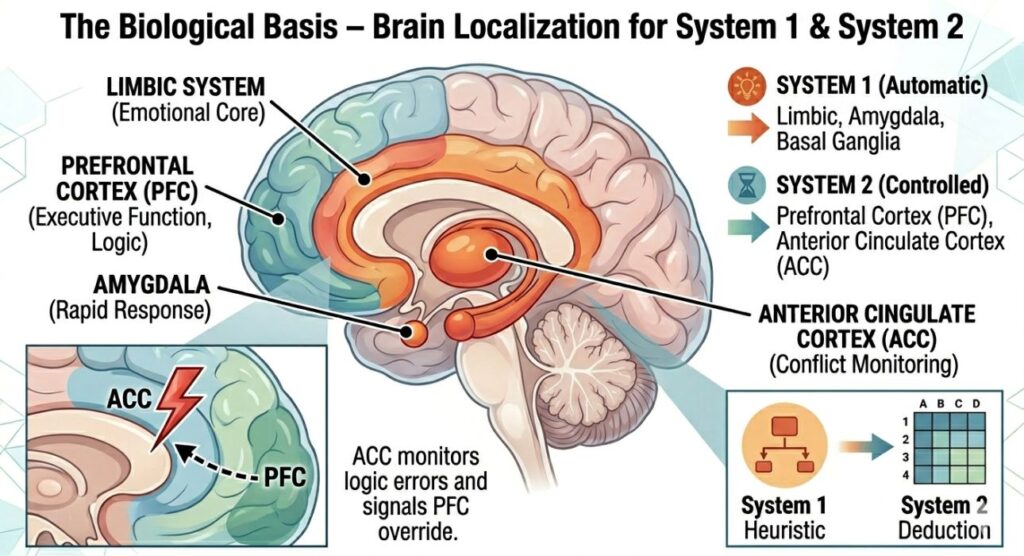
Image Source: Image Generated Using Gemini by Google, 2026
Neuroimaging studies (fMRI) show that systems 1 and 2 correlate with particular neural structures. It is with biological grounding that Dual Process Theory makes sense.
- System 1 (The Emotional/Habitual Core): Found in the amygdala, basal ganglia, limbic system (evolutionarily older structures). It is the regions of the brain where reactions of intense speed, deep, or unconscious survival responses and emotional processing take place.
- System 2 (The executive control): Remains mainly in the prefrontal cortex (PFC) and the anterior cingulate cortex (ACC). These “newer” brain regions handle deliberate logic, abstract reasoning and impulse inhibition.
Heuristics and Biases
System 1 in Action
Heuristics are the rule-based procedures in the decision-making process that can, if not quite optimal, provide imperfect responses to certain questions. For all their speed, they generate systematic mistakes.
1. The Availability Heuristic
This is the habit of judging the frequency or probability of an event by how easily events come to mind (Tversky & Kahneman, 1973). For example, a traveller may, having watched news reports about an aeroplane crash, conclude that flying is more hazardous than driving. System 1 responds to the vividness of the memory, not the probability data.
2. The Representativeness Heuristic
This is assigning a probability that an object or event A is assigned to class B based on how closely A follows B. Example (The Linda Problem): Participants were asked about “Linda,” a politically active woman. When asked whether she was (a) more likely to be a bank teller or (b) a bank teller who was involved in the feminist movement, most voted (b). That, of course, is a logical fallacy, the “conjunction fallacy”, which is the probability of two things happening simultaneously is always lower than one thing happening in and of itself. Its representativeness (Tversky & Kahneman, 1983) “fools System 1.”
System 2 and Cognition Power
System 2 is characterised by Executive Function. It makes up the working memory, cognitive flexibility and inhibitory control. System 2 is what we call “de-biasing”, the ability to override a System 1 impulse.
- Cognitive Decoupling: It is the mental ability to “disconnect” a thought from reality so that you can run a mental simulation or perform a logical operation without being distracted by your immediate environment or your gut instincts.
According to Stanovich (2009), the fundamental role of System 2 is “decoupling.” And this is the splitting apart of mental representation from reality. To think hypothetically (e.g., “What if I hadn’t taken that job?”), System 2 needs to “decouple” the primary representation to implement the mental simulation. This is the underpinning of critical thinking and long-term planning.
Interaction Between the Systems
The two, of course, are not completely independent; they serve as “default-interventionist.” System 1 consistently generates “intuitions” (impressions, feelings, and inclinations). When System 2 supports this belief, they become beliefs and a voluntary action (Evans, 2008). Conflict between the systems is widespread. A good example is the Stroop Effect. When asked to name the ink colour of the word “RED” printed in blue ink, System 1 automatically reads the word, while System 2 must struggle to inhibit that response and name the colour instead.
Applications in Public Policy and Economics
Dual Process Theory birthed the field of Behavioural Economics. If people were System 2 only thinkers (the Homo Economicus model), they would always make rational choices. But since we are “predictably irrational” (Ariely, 2008), all governments resort to Nudges. A “nudge” is a policy intervention designed to redirect System 1 toward a favourable consequence without undermining System 2’s flexibility (Thaler & Sunstein, 2008). For example, changing organ donation from “opt-in” to “opt-out” significantly increases registration rates. People tend to stick with the default (System 1 inertia); they try actively to alter it (System 2 effort).
Critical Perspectives and Other Modelling
Although the System 1 vs. System 2 framework comes with quite a bit of academic pushback, it’s a central teaching tool. To get a holistic grasp of the problem, we need to consider two prominent criticisms.
1. The Continuum Argument: A single process?
Scholars like Magda Osman (2004) dispute that it distorts the distinction between “System 1 & System 2” as a false dichotomy. Rather than two distinct “engines” in the brain, they propose a single cognitive mechanism that is like a continuum.
2. Automation through Practice
Tasks that start as “System 2” (such as learning to drive) eventually become “System 1” (automatic). Critics contend that although a process can slide back and forth, these are not two separate systems, but rather different fluencies or expertise levels.
Gigerenzer’s “Fast and Frugal” Heuristics
Gerd Gigerenzer offers the leading challenge to Kahneman’s viewpoint. He argues in turn that System 1 shortcuts are not “flaws” but Ecological Rationality, tools adapted to a fast-moving, uncertain world such that we don’t have leisure for detailed logic.
- The Adaptive Toolbox: Gigerenzer doesn’t see the mind as a “lazy” computer, but as a “Swiss Army Knife.” He shows us that by following simple rules like the Recognition Heuristic, there are better real-world results than slow, “System 2” statistical models.
- Rationality Is Redefined: For Gigerenzer, being “rational” is not about following math rules, but a decision that fits your environment.
Conclusion
Dual Process Theory posits that the human mind is in two systems at the very deepest level: System 1 (Intuitive) and System 2 (Reflective). System 1 is quick, automatic and emotionally driven, relying on heuristics to determine decision-making with immediate consequences that are very much needed for survival but are also subject to cognitive bias (Kahneman, 2011).
By contrast, System 2 is slow, rigorous, and logic-based; it offers the mental structure needed for complex problem solving and critical thinking (Evans & Stanovich, 2013). The complex interplay of these systems forms a framework of human intelligence; System 1 manages the “autopilot” of life, and System 2 acts as the “architect” of the human experience that can override impulsive reflexes when accuracy is paramount. Knowing when one should lean on a gut feeling and when one should call for more analytical rigour helps one deal with personal behaviours and public policies.
Read More from Us
- What is Theory of Mind?
- Maslow’s Hierarchy of Needs
- Vygotsky’s Language Acquisition Theory
- Drive Theory: Understanding the Force Behind Motivation
- Bowlby’s Attachment Theory and Its Lasting Impact on Modern Parenting Models
References +
- Ariely, D. (2008). Predictably irrational: The hidden forces that shape our decisions. HarperCollins.
- Evans, J. S. B. (2008). Dual-processing accounts of reasoning, judgment, and social cognition. Annual Review of Psychology, 59, 255–278. https://doi.org/10.1146/annurev.psych.59.103006.093629
- Evans, J. S. B., & Stanovich, K. E. (2013). Dual-process theories of higher cognition: Advancing the debate. Perspectives on Psychological Science, 8(3), 223–241. https://doi.org/10.1177/1745691612460685
- Kahneman, D. (2011). Thinking, fast and slow. Farrar, Straus and Giroux.
- Osman, M. (2004). An evaluation of dual-process theories of reasoning. Psychonomic Bulletin & Review, 11(6), 988–1010. https://doi.org/10.3758/BF03196730
- Petty, R. E., & Cacioppo, J. T. (1986). The Elaboration Likelihood Model of persuasion. Advances in Experimental Social Psychology, 19, 123–205. https://doi.org/10.1016/S0065-2601(08)60214-2
- Stanovich, K. E. (2009). Decision-making and rationality in the modern world. Oxford University Press.
- Stanovich, K. E., & West, R. F. (2000). Individual differences in reasoning: Implications for the rationality debate? Behavioural and Brain Sciences, 23(5), 645–665. https://doi.org/10.1017/S0140525X00003435
- Thaler, R. H., & Sunstein, C. R. (2008). Nudge: Improving decisions about health, wealth, and happiness. Yale University Press.
- Tversky, A., & Kahneman, D. (1973). Availability: A heuristic for judging frequency and probability. Cognitive Psychology, 5(2), 207–232. https://doi.org/10.1016/0010-0285(73)90033-9
- Tversky, A., & Kahneman, D. (1974). Judgment under uncertainty: Heuristics and biases. Science, 185(4157), 1124–1131. https://doi.org/10.1126/science.185.4157.1124
- Tversky, A., & Kahneman, D. (1983). Extensional versus intuitive reasoning: The conjunction fallacy in probability judgment. Psychological Review, 90(4), 293–315. https://doi.org/10.1037/0033- 295X.90.4.293
- Wason, P. C. (1966). Reasoning. In B. M. Foss (Ed.), New horizons in psychology (pp. 135–151). Penguin.
2 Comments