


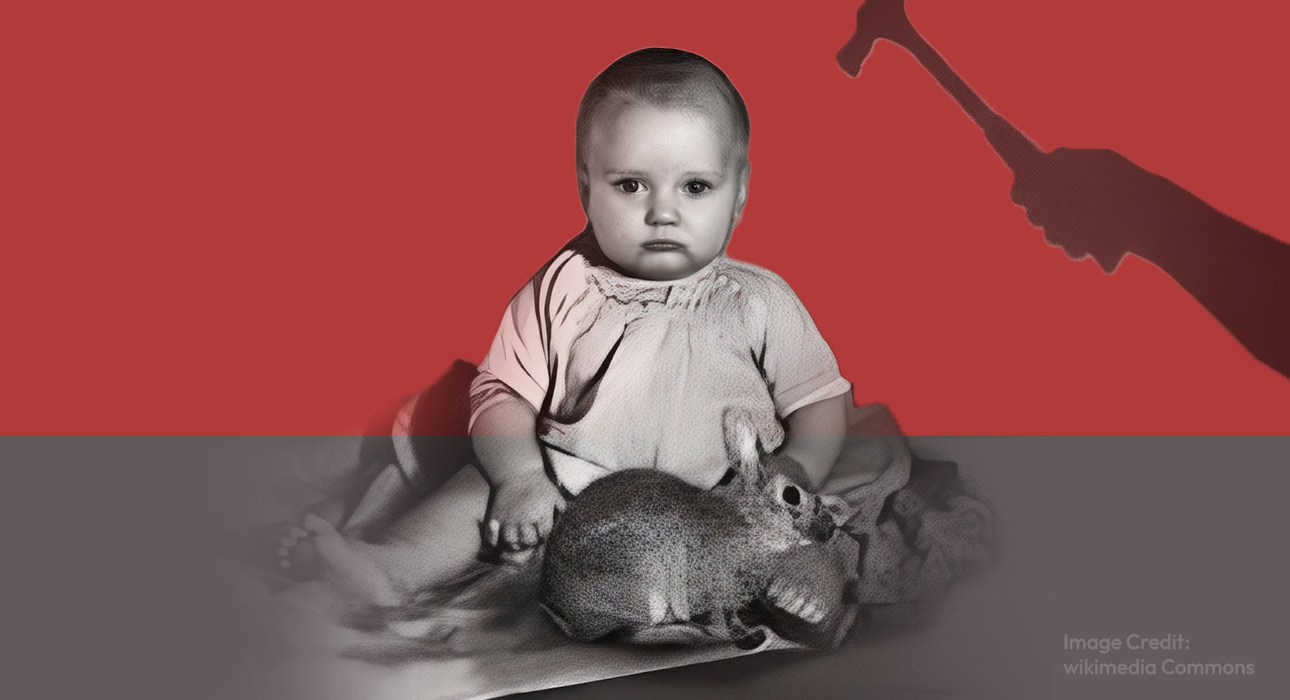
The success of Ivan Pavlov in conditioning physiological responses in dogs captured the attention of the psychological community. This happened at the turn of the 20th century. But the father of behaviourism, John B. Watson, attempted to demonstrate that human emotions were equally malleable. In 1920, Watson and his graduate student Rosalie Rayner performed an experiment at Johns Hopkins University. This would be one of the most ethically controversial milestones in science. The case involved an 11-month-old baby named Little Albert. Watson aimed to show that fear is not inborn, but acquired, a fact he established by systematically terrorising a helpless infant.
The Machinery of Conditioned Terror
The methodology of Watson was based on the rigid tenets of behaviourism, which states that all behavioural forms are a product of stimulus-response associations. Watson applied the concept of classical conditioning to change a neutral object to a source of terror (Watson & Rayner, 1920). The experiment took a very specific, chilling order:
- The Neutral Stimulus (NS): The first stimulus was given to Albert, where he was offered a white rat. It was noted that he was not afraid and even reached out to the animal to touch it with curiosity.
- The Unconditioned Stimulus (UCS): Watson introduced a loud, jarring noise by striking a steel bar with a hammer behind Albert’s head. This naturally produced an unconditioned response of fear and crying.
- The Association: Watson began pairing the two. Every time Albert attempted to play with the rat, Watson struck the steel bar.
- The Conditioned Stimulus (CS): Eventually, the mere sight of the rat without the noise caused Albert to burst into tears and attempt to crawl away. The child had successfully been “programmed” to associate the soft animal with a terrifying auditory assault.
Stimulus Generalisation: The Spreading of Fear
The experiment’s findings were made more disturbing by a phenomenon known as stimulus generalisation. Watson and Rayner (1920) observed that Albert’s fear did not remain confined to the white rat. Instead, his distress spread to other furry objects that shared similar characteristics. Albert began to exhibit fearful reactions toward a rabbit, a dog, a sealskin coat, and even a Santa Claus mask with a white cotton beard. This demonstrated that conditioned fear is a blunt instrument; once a phobia is established, it can bleed into various aspects of an individual’s life, creating a generalised state of anxiety toward any stimulus that vaguely resembles the original source of trauma.
The Ethical Abyss: A Permanent Imprint
From a modern perspective, the “dark” nature of the experiment is most evident in its conclusion. Watson originally planned to “recondition” Albert to unlearn the fear, but someone removed the child from the hospital before he could do so. Watson had successfully broken the child’s sense of safety to prove a scientific point, yet he provided no psychological repair (Harris, 1979).
In today’s psychological practice, such an experiment would be a catastrophic violation of the American Psychological Association’s (APA) ethical codes. The lack of informed consent from a legal guardian and the intentional infliction of psychological harm without a plan for mitigation highlight a period where scientific curiosity often overrode human rights.
The Mystery of Albert’s Identity
For decades, the fate of the child was unknown. In 2009, researcher Hall P. Beck identified “Albert” as Douglas Merritte, the son of a wet nurse at the university. Sadly, it was documented that Douglas died aged six due to hydrocephalus (Beck et al., 2009). Assuming that Douglas was Little Albert, this suggests that he might have been neurologically impaired at the time of the experiment, which would further nullify Watson’s claim that he had selected a healthy and stable subject. Subsequent studies by Powell et al. (2014) challenged this, saying that the child may have been William Barger, who lived into his eighties but allegedly had a lifelong, unexplained aversion to furry animals. No matter who he was, the psychological trauma caused by the experiment was probably irreparable.
Conclusion: The Legacy of Controlled Fear
The Little Albert experiment is a classical work in behaviourism, as it demonstrated that it is possible to manipulate the emotions of individuals by manipulating the environment. It demonstrated that people can learn fear and unlearn it, and it opened the way to contemporary therapies, including systematic desensitisation. But the experiment is a bleak reminder of the perils of detached science. Watson saw Albert not as a person, but as a biological machine that he could program. Although the experiment helped us understand how phobias work, it came at the expense of the tranquillity of a child, which showed that the greatest lesson of the Little Albert experiment is that there must always be an ethical limit to the pursuit of knowledge.
Read More from Us
- Maslow’s Hierarchy of Needs
- The History and Evolution of Abnormal Psychology
- The Bystander Effect: Why do people hesitate to help in emergencies
- Diathesis Stress Model: From Predisposition to Psychological Disorder
- Bowlby’s Attachment Theory and Its Lasting Impact on Modern Parenting Models
References +
- Beck, H. P., Levinson, S., & Irons, G. (2009). Finding little Albert: A journey to John B. Watson’s infant laboratory. American Psychologist, 64(7), 605–614. https://doi.org/10.1037/a0017234
- Harris, B. (1979). Whatever happened to little Albert? American Psychologist, 34(2), 151–160. https://doi.org/10.1037/0003-066X.34.2.151
- Powell, R. A., Digdon, N., Harris, B., & Smithson, C. (2014). Correcting the record on Watson, Rayner, and Little Albert: Albert Barger as “Psychology’s lost boy”. American Psychologist, 69(6), 600–611. https://doi.org/10.1037/a0036854
- Watson, J. B., & Rayner, R. (1920). Conditioned emotional reactions. Journal of Experimental Psychology, 3(1), 1–14. https://doi.org/10.1037/h0069608